PHOTO
How does nature return to life after fire and how can we help?
Our ancient landscape has withstood fire for millennia.
Plants and many animals have adaptive behaviour to cope with fire events; however, our recent Longwood fire will surely create local extinctions for some species due to the extent - and in some areas the intensity - of the fire in a landscape already stressed with drought and fragmentation.
So, what are the signs nature is recovering, and what can we do to assist this process?
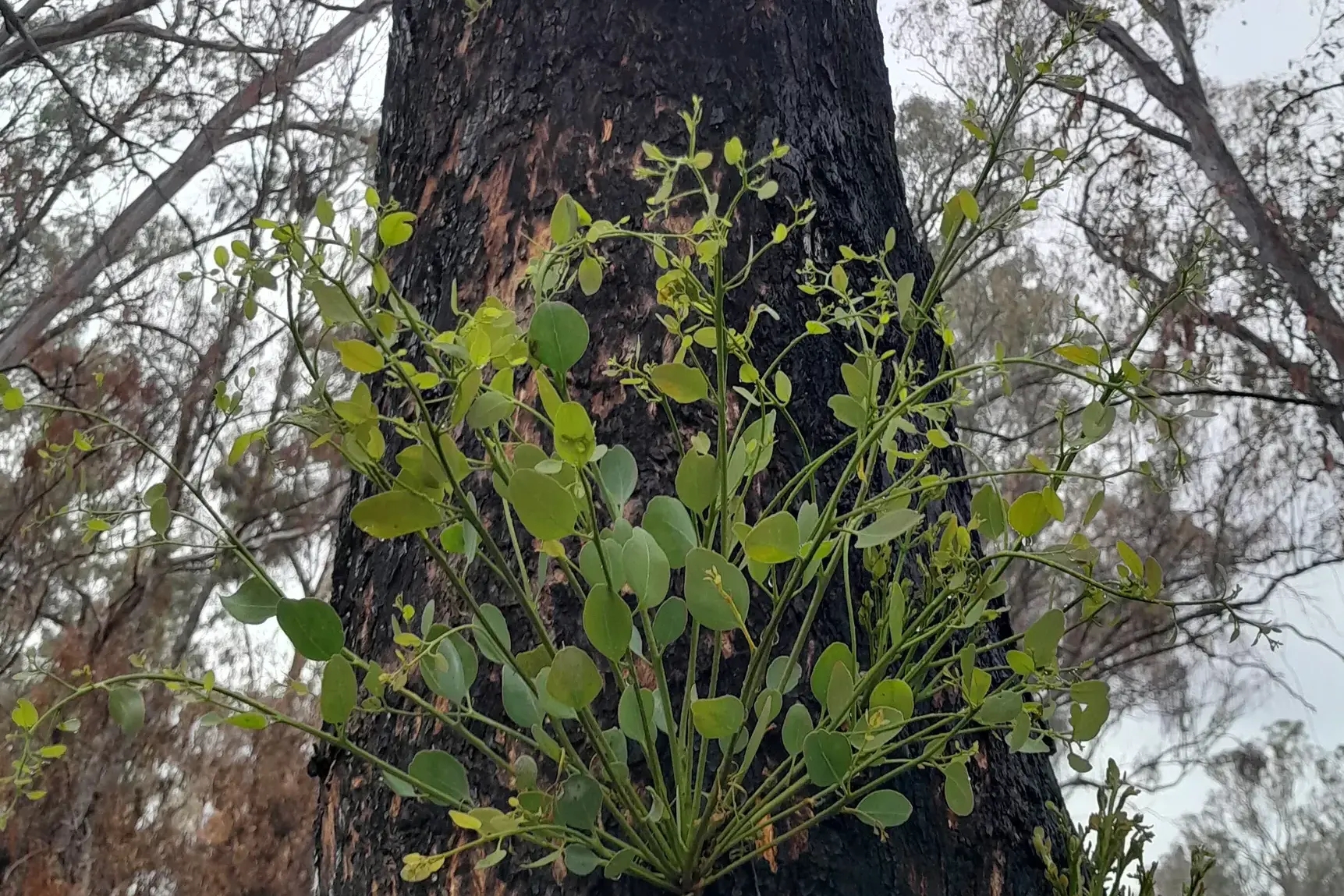
Our eucalypts are showing some of the most visual signs of recovery currently: from blackened, scarred trunks, green, juvenile leaves are emerging.
Far from looking dead, the 'epicormic' buds, scattered up the trunk and branches of eucalypts beneath the burnt bark begin to emerge.
Sometimes growing up to 26cm per day, these little shoots and branches allow the tree to photosynthesise and recover their supply of sugars.
Roots deep in the earth, connected to fungal threads, continue to seek nutrients and moisture and distribute these to the plant in exchange for sugar.
Our eucalypts are on the mend.
Unfortunately, the hollow bearing trees, the matriarchs and ancients of our landscape, have taken a heavy loss.
Many are centuries old, supporting countless insects, birds, possums, gliders, bats, and lizards.
Many now lie fallen.
Early estimates might suggest 90% of these ancients have succumbed, numbering into their thousands across the burnt country.
Their very feature - their dry, hollow core - has allowed fire at the base of the trunk to act as a chimney, drawing smoke and flame into the heart of the tree.
Such a loss is unbearable and will have repercussions for decades for hollow dwelling animals.
Trees take at least 100 years to develop hollows, and many birds, bats, owls, possums, gliders, and phascogales either depend on them year round or seasonally to breed; thus, there is urgency to begin the task of building artificial hollows.
This time in our Country is hard but don’t turn your back because it is too painful.
Take photos, visit, observe, make nest boxes and art.
Celebrate each of those incremental signs that our landscape is recovering and take time out for yourself.
We are keen to help too, so please register your interest or your property through the BRA website at biodiversityrecoveryalliance.com