
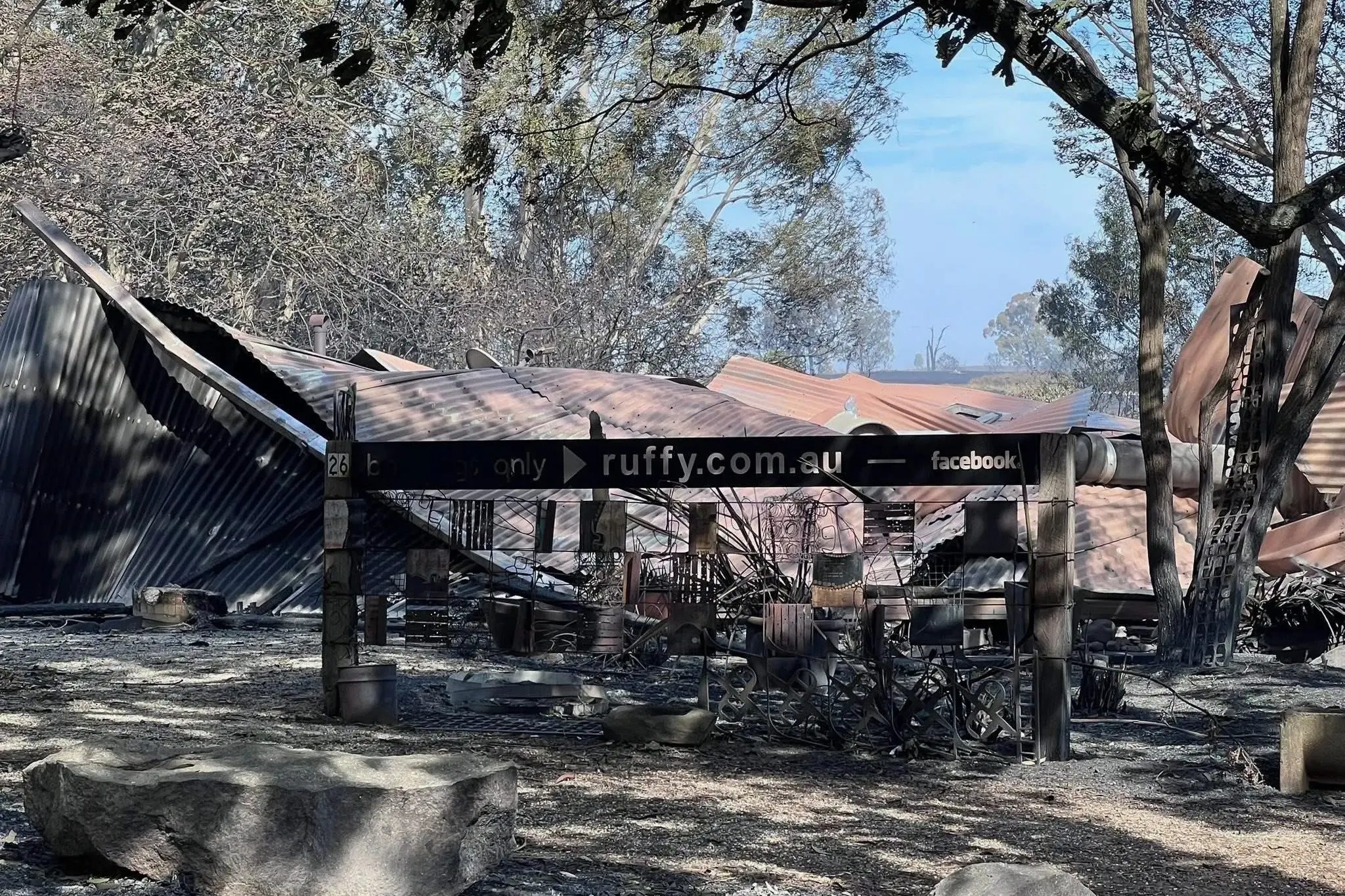
PHOTO
Fire impacting the Strathbogie, Murrindindi and Mansfield shires in a horrifying bushfire over the past week, destroyed and damaged more than 100 structures and thousands of acres of grazing land.
As of Monday afternoon the fires continued to burn, although at a slower pace as the weather conditions had eased.
Many residents have been displaced, many not being able to return to their homes as of early this week, and authorities have yet to gain access to some areas in order to assess the full extent of destruction caused by the Longwood Complex fire.
The massive blaze has stretched from Longwood through to Alexandra across to Ancona and nearing Bonnie Doon with its western flank reaching the outskirts of Seymour, spanning a vast area of central Victoria.
The fire, which started on Wednesday, 7 January, is expected to have a lasting impact on the region.
Wednesday (7 January) marked the beginning of three extremely hot days across Victoria, as a large mass of heat from Australia’s interior spread across the state.
Conditions worsened on Friday, which was declared a day of Catastrophic Fire Danger.
“The wind, heat and risk of dry lightning will increase the risk for unpredictable, uncontrollable and fast-moving fires,” Victoria’s Emergency Management Commissioner Tim Wiebusch said at the time.
“The last time we saw catastrophic fire danger ratings across multiple districts was on 21 November, 2019.”
An emergency warning issued at 3pm last Wednesday urged residents in Longwood, Longwood East, Ruffy, Tarcombe and Upton Hill to take immediate action as the fire moved south towards Oak Valley Road. Water-bombing aircraft were deployed in an effort to slow the fire’s spread.
However, by Thursday, rapidly shifting winds and tinder-dry conditions intensified the threat, placing Ruffy and surrounding areas directly in the fire’s path. By the afternoon, the fire had pushed through the area.
Community relief centres were opened as conditions deteriorated.
On Thursday, evacuees were directed to Seymour, where a relief centre was established on Pollard Street.
The Hume Highway was closed in both directions between Seymour and Violet Town, with motorists advised to detour via the Goulburn Valley Freeway and Murchison–Violet Town Road.
Friday proved to be the most dangerous day, with wind gusts reaching up to 76km/h.
These conditions drove the fire across multiple shires, impacting the townships of Alexandra, Yarck and Merton.
Authorities believe the fire generated its own weather system, with lightning strikes reportedly caused by intense heat and smoke columns.
Lucky escape:
Local Ruffy resident Pam Bannister said she was extremely lucky to escape, despite losing her home.
“I had backpackers from France staying with me, and I went over to Yarck on Wednesday afternoon to pick them up from the cherry farm,” Ms Bannister said.
“That’s when we got the notification about the fire. We thought it was safe to go back to the house to get our belongings, but by the time we arrived at Yarck we could see the smoke and knew we had to stay there.”
Ms Bannister and her guests stayed overnight at the local pub after being taken in by a local couple.
“The next day we headed back to get passports and a few clothes,” she said.
“As for my home, it’s gone.”
She is now staying with a friend in Euroa while waiting for permission to return and assess the damage. One of her neighbours was forced to save himself by jumping into a dam as the fire passed through.
Fundng Assistance:
Victorian Premier Jacinta Allan, alongside the federal government, announced hardship payments for affected residents.
Throughout the day, power outages affected more than 90,000 people across the state, while electricity distributor Powercor urged customers to plan ahead amid extreme weather. Limited mobile service access and water constraints from Goulburn Valley Water further compounded the crisis.
Early Saturday morning, Premier Allan declared a State of Disaster.
“This declaration gives our authorities extra powers to confront an emergency of extraordinary scale and danger,” she said.
As of Saturday evening, the Longwood fire had burned more than 144,000 hectares of land, with around 150 structures estimated to have been lost.
The fire’s north-eastern edge flared, requiring ground crews and water-bombing aircraft to prevent the northern flank from crossing the Merton–Mansfield Road and advancing further towards the Strathbogie region. Constant southerly winds kept other fronts subdued.
Strathbogie resident and Lieutenant of the Strathbogie CFA unit, Tanya Lumley, described the relentless conditions faced by crews.
“The power’s been off in Strathbogie since Thursday night,” she said. “Crews have been camped out in the hall across the road from the station, trying to sleep when they can. Trucks have been consistently deployed since then.”
Firefighters have been operating in shifts to crew multiple vehicles, supported by strike teams from across Victoria.
“We’ve had crews from all over the state, but unfortunately now a lot of the state is also on fire,” Ms Lumley said.
Despite the ongoing threat, she said the Strathbogie community had prepared extensively for fire seasons.
“Every year we hold a Bushfire Sunday where CFA professionals come and talk to the community, help people understand their plans and make sure they can be actioned on days like this,” she said.
“We hope that knowledge is keeping people safe, off the roads and following the advice of VicEmergency notifications.”
As of Monday, 10 January, the fires had entered their sixth day.
Full damage assessments are yet to be completed, and one fatality has been reported in the township of Gobur.
While the blaze has been downgraded to a Watch and Act, many roads remain closed in affected areas.
Fire authorities continue to monitor conditions closely as crews work to contain the blaze and protect communities across central Victoria. For more information, residents are urged to use the VicEmergency app, or call 000 if in danger.