PHOTO
Victoria's Governor visited Euroa on Thursday 26 February as part of a tour of bushfire affected areas through both Strathbogie and Murrindindi Shires.
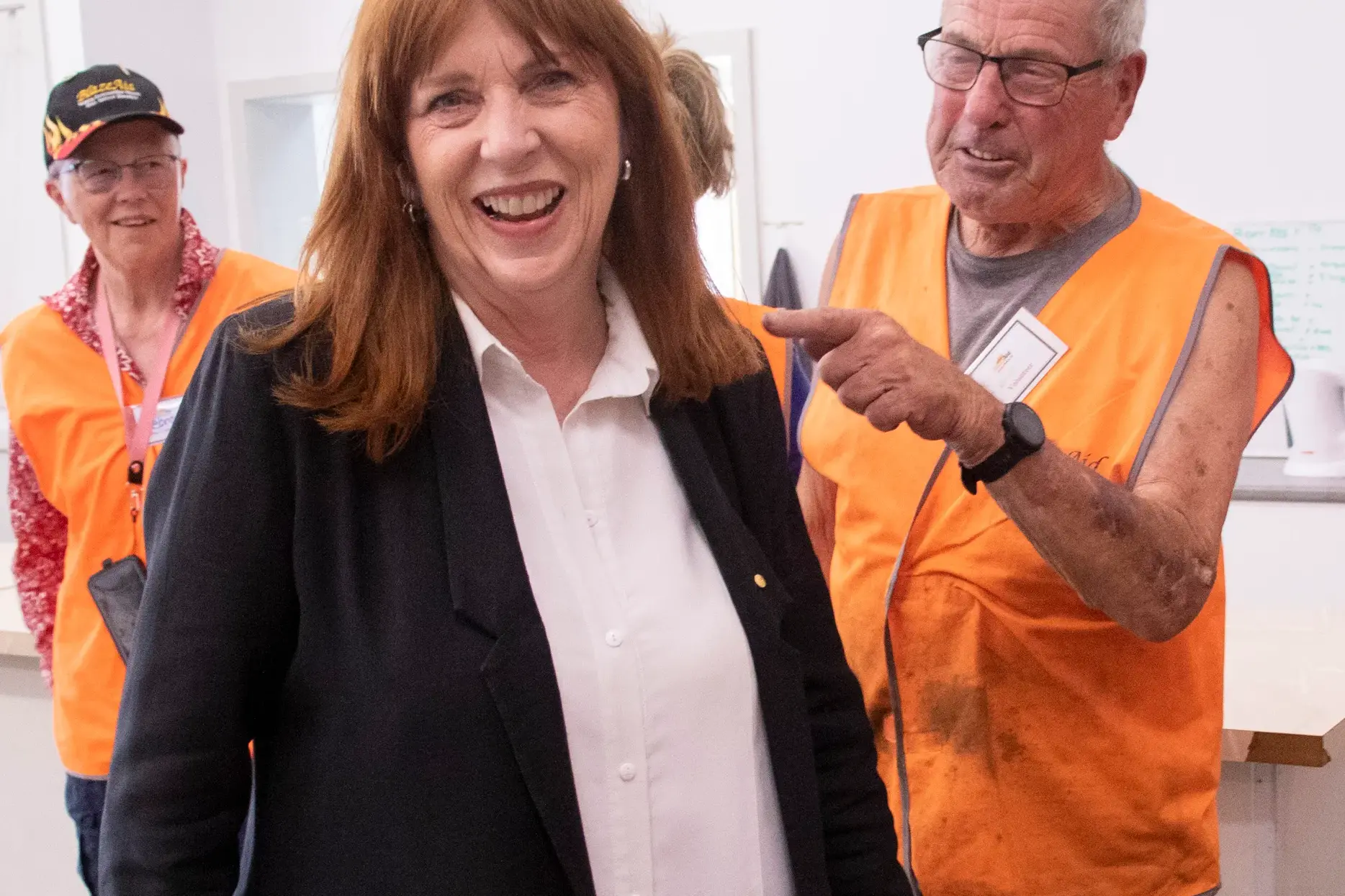
Her Excellency Professor the Honourable Margaret Gardner AC visited the BlazeAid camp in Euroa as part of a broader visit to bushfire-affected areas which included Highlands, Upton Hill, and Mansfield.
Governor Gardner met with over 30 BlazeAid Volunteers at the Euroa Showgrounds, along with Strathbogie Shire Mayor Scott Jeffery and Victoria's Emergency Management Commissioner Tim Wiebusch, and heard anecdotes of the effort the volunteers had been making with fire-affected farmers.
Governor Gardner told the group that her own son had volunteered with BlazeAid in the past and then personally thanked those who had travelled from across the state and from as far away as Perth.
"It's wonderful that you can do this," she said.
"It makes such a difference when people in a crisis of that sort have the feeling of being isolated and on their own, which is just a horrible feeling.
"But people being there, saying they are here to help - I think all the things you're doing helps makes a major difference.
"One of the things we do particularly well in Australia is something I see again and again - the volunteering we do is really quite spectacular.
"Sometimes I don't think that's appreciated enough."
One of the BlazeAid stalwarts was Allen Valerius, who after six weeks of volunteering said he had developed a sense of how appreciative farmers were for the work done.
"Our job is to reassure them that we are going to help them and we have been doing just that," Mr Valerius said.
"Everybody is so thankful, and for me personally I am so happy to do it.
"You really get personal satisfaction form it."
Two US college friends were commended for cutting short their working holiday to join the team for four weeks.
Commissioner Wiebusch also thanked those who had been getting their 'hands dirty'.
"It's important to see people can be making a step forward," Mr Wiebusch said.
"Thanks for making a start for the next phase because it is very much appreciated."
BlazeAid coordinator Debra Ong said the organisation thrived on helping farmers, and explained the relatively uncomplicated approval process for landholders to get BlazeAid's help.
"Amanda Wylie [assistant coordinator] and I ask 'so has your fence been affected by fire?' and if yes is the answer then we say 'then you have approval for our help'," Ms Ong said.
She also said each fencing group was made up of mixed ages, genders, and abilities.
"The common denominator is that they all want to help," she said.
A common theme volunteers agreed on was the unwillingness of farmers to accept help.
"People say 'oh no, go to those people who really need it'," Ms Ong said.
"But when Amanda and I talk to them, then Amanda and I discover that they are really quite a high priority."
Mr Valerius said one farmer with badly burnt hands was reluctant to accept help but finally acknowledged the importance of the work given.
"He said it would have taken him two months to do what we did in three days," Mr Valerius said.
"I said to him 'that's what we're here for'."
Ms Ong outlined the estimated $1.2 million that had been spent 'in-kind' to farmers since the Euroa BlazeAid camp opened in January.
"It is - at least - that each kilometre of land clearing is valued at $3500 as an in-kind investment, and for every kilometre it becomes $9500," she said.
Governor Gardner weighed in with her own expertise as a former economist.
"It's not just the fences, but it's what they then generate for the farm," she said.
"Once the fences are up, there is a multiplying effect which is probably much higher than $1.2m."
Governor Gardner told this masthead that she had not come with any message for the people of Strathbogie Shire, but was here to listen.
"What I come for is to hear from (locals) about how they are experiencing and dealing with the impact of this really significant crisis and the sorts of things that they are doing because so much of it is supported by community and volunteering work themselves," she said.
"They drive a lot of their own response, but they also see the things that are affecting them and I come to actually hear that, and you hear slightly different things depending where you are and how it's affecting (them) and the sorts of issues that are paramount for them.
"It's not what I can tell them - it's what they're telling me so I can better understand what's happening around the state.
"I want to take that and discuss with people who have to make policies and who are actually themselves organising together to support their communities."
She said the Longwood bushfire was one of the most significant fires Victoria had faced.
"The issue here is hearing people talk about the speed at which the fire overtook them, and also the scale.
"This was a very large scale set of fires across all the state in January, and so the huge impact on very large portions of the state you get a sense of by driving through it.
"It's almost beyond comprehending by looking at - the drive just brings home to you, well, this is what it looks like after it's gone through."