
PHOTO
The Euroa Gazette’s Andy Wilson knows that his battle with the Longwood bushfire does not come close to what the farmers and winemakers around him endured and suffered. He did not ask for a front row seat of the disaster, but found himself locked into the area among passing-by locals who shared everything from food to their personal heartache. He has used pseudonyms in this account; but they are all heroes.
THE HUMANITY among the catastrophe of the Longwood bushfires is what sticks in the craw of this correspondent who chose to stay and protect his remote small home on day two of the ongoing fires.
By any measure, a person’s loss lies on their own scale of shatter, and you cannot compare between any individual’s or family’s forfeit.
My losses were significant and have quite affected me; others’ were far, far worse.
A farmer approaching my house in an excavator on day four broke down with no shame after a five-minute front of merriment – he’d lost everything. Livelihood gone.
“We’re buggered – I think I’m out of here,” he said.
One neighbour had a team busy shooting hundreds of sheep, which took days (as well as bullets imported from NSW).
How stupid did I feel when I told them about two near dead sheep beside my dam?
I used some farm slaughterhouse experience to bring them mercy.
Another good mate lost his entire vineyard and then his home after a flare up the next day.
These are people’s livelihoods and their very lives affected deeply; on their scale, it’s at 100.
I lost a hell of a lot, but it didn’t affect my income and I still have my home. I cannot put a number on it.
My good mate James on the other side of the hill lost his house, including the walls covered with printouts of every single photo of his grandchildren that he ever gets sent; and here I was scheduled to water his pot plants that very week.
(He is safe and sound in Melbourne.)
In Ruffy, the carnage is indescribable, the donations overflowing such that social media posts now list off what is no longer needed, thanks.
And remember the ‘forgotten fire’ north of the shire which swept away 12 houses in its path and could have taken Katamatite.
My losses do not compare, and I cannot even grasp at what the pain is like right now for others.
THE HUMAN TOUCH after the madness is so rich that every encounter with someone can get emotional – I felt tears welling with every brief conversation I had with CFA folk across the week as they dealt with the bigger spot fires around me.
Strangers from across the state got locked in too and stopped by with water, food and beer, and had rifles if I needed anything shot.
“I’m down to a bottle of garlic aioli and it’s looking tempting,” I said.
“Put some of this under it”, and I was flung a bag of bread rolls.
The human touch had generated around me, however, on the day beforehand which heralded in the gravity of the situation.
“Whatever you do, don’t be a bloody hero,” said Saul, my mentor and a local farmer.
“Don’t worry about covering the story, get home,” came from my boss after I had tailed the fire from the Hume Freeway up Oak Gully Road in its first few hours.
And then a text from dear friend Tiger: “Go to the winery and when you get there, call me.”
Her text had me hold back tears.
I followed all three instructions and then a fourth when Saul came back with a morsel that proved valuable.
“Have a box of matches in your pocket at all times – you may need to back burn.”
A cigarette lighter sufficed. And a spare.
Night fell and from my place the red glow looked like it was half a kilometre away and so I set out on foot with camera across paddock after paddock with each hill tantalising me with the hint that the front was just over the next rise.
I walked six kilometres in the dark, climbing equally as many fences, traversing blackberry-filled gullies. In my best jeans, mind.
The helicopters left the very moment I arrived at the front so my photos were reduced to only a few burning trees and within 12 hours would be reduced to a few dollops of melted camera.
A man stood beside his semi-trailer water carrier in the dark.
“I want to go home, I’m exhausted,” he said.
“They won’t let me through, but the water needs to get there.”
That moment was when the silence hit me, possibly an involuntary response we are built with to shut out what is not necessary, to stay sharp.
I was driven home via a more sensible route in the back of a ute, clinging to the lid of a water tank that took up all the space, my mouth closed to the barrage of night insects.
My phone fell from my pocket on arrival and was lucky not to be crushed as my chauffeurs executed a hurried three-point turn.
The screen had cracked but it still worked.
'NOTHING PREPARES YOU' are words that ring hollow for me.
Everything prepares us and this masthead receives and publishes story after story from all emergency services and politicians to ensure people are prepared.
There really is no excuse.
Leave now: problem solved.
Stay and defend: problems arise but solutions evolve.
This was the third fire I have faced: one of them that charged at my farm in Tasmania changed direction at the last minute; another – although a long way off – rained down ash and blinded us in red smoke as we tried to gently float six horses out of that hell.
My fire survival plan has got tweaked each time and will of course now see a few more improvements.
Last minute calls and texts from people telling me to get-the-hell-out-of-there could not be parried in enough time with a lengthy explanation of my prior experiences, so I ignored them and let people think I was a very green journalist heading to his doom.
The local CFA captain – a good mate – came past just before the fire front breached the hill opposite and inspected my setup, delivering the real shot in the arm.
“What are you going to do?”
“I will stay and defend.”
“Are you sure?”
“I am.”
It’s all very official – verbal paperwork if you will – and his cool bearing gave me enough confidence.
Then he turned around while leaving and packed the real punch which saw me grow about a foot taller: “I think you’ll be fine, mate.”
That was all I needed; he drove off.
A CFA truck made a quick visit where we watched together as the long strip of flame appeared over that last rise, its right flank surging ahead and tearing under the vineyards opposite, the rest charging directly toward us.
“Well here comes the front, mate,” said one of the firerys.
“You’re gonna be OK.”
Their position between the fuel-laden other side of the road and my short mown and well-soaked lawn would have had them in peril, so they left for some other priority.
I was on my own.
I TOOK SOME final photos until it seemed like a stupid idea and even filmed the front arrive, for whatever purpose I do not know; and that was the last time I would think about my job for over a week.
The plan worked: gutters, filled to the brim with water, soon overflowed with a torrent of dried leaves and embers that rained down, but they didn’t ignite; the fire front stopped at the edge of the lawn; the three sprinklers held out until hoses melted but the longest hose in my hand stayed safe and stayed with me, shooting down every little spot fire.
I now hate garden furniture – take one guess.
The enormous trees opposite went up in flames and the random falling of huge burning boughs startled me with their crashes all afternoon and then into the night.
The front passed on either side of the house and it roared – not like I expected and nothing close to the firestorms of previous years throughout Australia – but at a metre-and-a-half tall it was sobering enough, thanks.
The house filled with more smoke than was outside, and the smoke detectors screamed for hours, yet I would take spells inside to cough up soot and to keep a clear head.
I panicked when I saw a sea of red cinders pour under the front door. How did I miss that?
I upended a vase of flowers onto a towel and I blocked the gap.
Then the disaster struck.
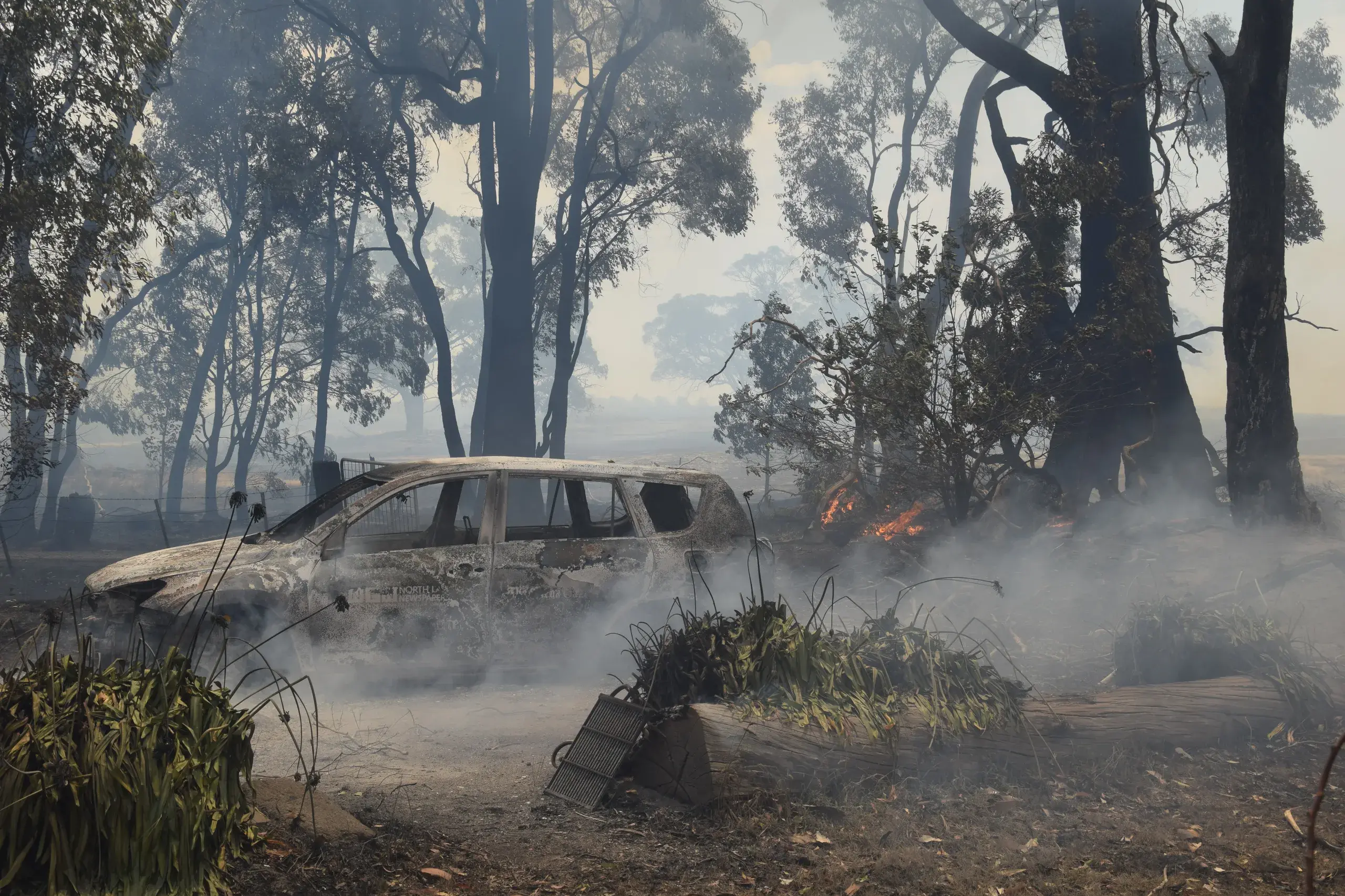
I found myself screaming as the work vehicle parked out the front – nestled I thought safely on gravel – went up in flames.
“Save the car!” I yelled to no one.
It was too hot for me to close in on with the hose.
Inside that vehicle was all the important things to be saved in an evacuation.
Start with my family’s 250-year-old bible filled with the Wilson genealogy and work your way forwards in time to my two Black Magic cinema cameras, laptop, brand new MacMini computer, wallet – the damned lot.
Two novels I was working on, $400 in fire preparation cash, and the work camera with God knows how many photos.
Priceless and numerous family heirlooms going back in some cases six generations went to ash.
We couldn’t even date a silver fob watch that I’d been the guardian of for 20 years.
The sudden loss numbed my mind but did not hold me back.
This house was bloody well staying.
I think the blessing from the CFA came largely from the five-acre dam which laps against the back of my home, the volunteers knowing that I’d leap into the big wet and let the house go if the time ever came.
I had an ‘out’, but the fire did not – so I stared the bloody thing down and I gave it hell.
My rear end came too close to the flames (you get to gauge different levels of heat through denim and can adjust proximity accordingly) and I felt my phone pop.
The screen went all colour-nuts and a few shouted texts via Siri was all that could be done.
I messaged a brother in Adelaide to contact this masthead and report in my status and impending lack of communication.
And tell Mum and Dad the same of course.
I messaged Tiger that I had made the right decision after all and then my sister in-law to get her to post on Facebook for people to stop bloody calling me.
The phone soon died.
At one point I jousted with a flame at the base of a fence post, hindered by some low branches – the flame piping and bouncing at the post’s rear, demon-like in jest at me as I sprayed back and forth, chasing the bugger peeping out from side to side.
The air conditioner unit went up, which called for the specially placed fire extinguisher which knocked it over easily, and at the other end of the house when the flames reached under the floor, the second extinguisher was at hand.
The vegetable garden, just starting to produce results, went to nothing in an instant and my ever-obliging flower garden – carnations like never before this year – vaporised.
Another CFA unit returned, assuring me in my adrenaline-fuelled state “Hey mate, it’s OK, it’s passed.”
Nope: those falling cinders would be the stuff of nightmares should I let my guard down for even one to catch the roof alight.
The crew topped up my gutters generously and left.
“AND WHEN YOU GET there, call me.”
My feet ached at the end of that day, the bones all felt sprained, the muscles strained and the soles each a big blister of agony whenever I stopped walking.
My best fitting boots had been in the car, along with my gloves – it had all been bare-handed. Bloody idiot.
Walking the 600 metres to the winery took an hour at such pace and in honesty I don’t know why I did it, except that I needed to see people or hear a voice.
All roads were blocked by debris, and it felt like a post-apocalyptic film: not a soul, and such silence even with the crackling trees.
I crossed horizontal fences and traversed paddocks to avoid the road and then shuffled through the hideous sight of an horizon-filling vineyard which had entirely cooked.
There was no one at the winery and an unlocked rear door let me in to the dark behemoth.
Two birds fluttered out from under the staircase and startled me.
I found the lunchroom unlocked and used the cigarette lighter as a torch to search pointlessly for a landline and even more so for Tiger’s phone number written on a list on a wall somewhere.
Neither existed but I laughed that I had followed her instructions to the letter.
Two litres of tepid milk in the fridge smelled just fine and I chugged it down.
The walk back was worse.
A SORT OF truce on that first night came with the wind dropping.
Through the front windows I stared at about 10 vertical tree trunks only 30 metres away, all aglow and some even in flame like sentries waiting for a second attack across no man’s land.
“Not on my watch you bastards; I’ll see you at dawn.”
I needed sleep and between the coughing fits a chilling nightmare woke me, that of the car burning with my children inside.
In another endless one I was breathing underwater in the dam, collecting burnt-out artefacts.
I then set to work as promised in a pre-dawn offensive on the day of an expected 43-degree heat and 50 kph winds.
Me, 12 buckets, and one dam.
The temperature and wind kept rising on that awful Friday for wherever the fronts (now plural) were at.
I had no radio, I had no clue, so I kept dousing, bucket after bucket from dam to stump and back again for seven days, with a change in pace really only coming about halfway through.
“Let them go, they’ll smolder for weeks,” I was advised.
Everyone loves that one and yes, I now have seen roots burn continuously into the ground, but they were too close to the house and random branches of crispy dry leaves would crash down occasionally and start a new fire, often upwind.
With the roads blocked and plenty of splash, I had no other plans.
THE HEROES KEPT stacking up.
Good mate Georgie stepped straight off an overseas flight and found me a spare iPhone so my family in Adelaide could hear my voice. They sent her flowers.
I reluctantly went to the Seymour refuge centre with brand new mate Greg on about day fourish (it becomes a blur), dressed head to toe in my finest soot where the acting Mayor threw an arm around me, an elderly gentleman under her other arm a blubbering mess.
“He’s lost everything,” she said.
I sat with now homeless 80-year-old Dennis while I awaited processing, mopping his lap as he trembled so hard that his coffee seemed a pointless exercise.
Young Elise and I crossed paths several times with her massive sooky dog in tow, and she smiled so beautifully then followed that with tears. No car. No home. Just a dog and that beautiful smile. We’ve kept in touch.
Triaged and treated for my sooty cough, showered (but soot remaining) and then food jammed down me, I allowed another friend to put me up for the night after a home cooked curry and a second shower that still didn’t seem to work that well.
The wind picked up by morning and I vanished, thumbing a ride back (Greg again) to find the stumps had not waited for me.
I backburned the side lawn (thanks again for the tip, Saul) and dug a small moat which drew from a siphon in the rainwater tank.
A massive tree fell and exploded into life while the wind was gunning straight at the home, throwing embers.
Phoning triple zero was incredulous.
We have the technology I am sure for mobiles in a bushfire zone to go straight to the CFA, but no, I went to a national call centre, had to repeat the name of my road twice and the area twice.
“You ever watch the news, buddy?”
Then I was transferred to the state’s metropolitan fire department while watching this blazing tree get bigger and bigger, and even then, it seemed to be news to them.
"Can you just spell that suburb name again, sir, but slowly?"
Suburb. Right.
When three trucks arrived, the wind had swung right around, and they told me the tree was not a threat. I felt stupid, but one volunteer was assuring.
“Hey, we need you; you’re our eyes and ears. You did the right thing.”
When I got through my last pair of boots (my football ones no less) good mate Joey arranged through local hero Marty a new pair for collection at the service station.
Tiger brought the boots up when the road was opened and we hugged tightly amid, curiously, a volley of name-calling jokes that seemed to be our coping mechanism throughout.
"I was worried about you, ya bastard."
"Yeah, well I did everything you told me to do."
Stranger things unfolded.
I found myself dousing the flaring stumps in satin pyjama pants one morning (my best clothes went with the car) and on another day had my apparel of just boots, no socks, and underpants questioned by another passing local armed with bread, water, and beer.
The wallaby that had tormented me all spring with his taste for my roses and vegetable garden took refuge behind my house in the only patch of lengthy green grass for miles.
I walk right past him now and he doesn’t flinch.
THE HALF DOZEN or so coughing fits at night were awful.
I climbed ladders to pummel red glowing knotholes or pour nine litres of unbalanced water first straight on top of me until I got my eye in and sent them down hollow smoking trunks.
One third of a bucket, instead of a full one, is better for accuracy with a bit of a swirl, and if flinging a three-litre jet into a small hole was an Olympic event, I’d be in medal contention.
Very dark humour sustained me: during the fire I counted out aloud the four large bangs as each car tyre exploded – then a fifth caught me off guard.
“That’s right, I forgot the spare.”
Seconds after saying out aloud “I wonder when the fuel tank will go” there was an almighty boom, as if it had been scripted.
Coffee was brewed each morning on a selected overnight flareup, which I actually thanked before drowning its embers with water and a “take that, ya bastard”.
I thrilled at the sound of the bubbling muddy ash with each stump and seemed to get more furious with them if they ever came back. One did so for five days straight.
A later flare up from a fallen branch close to the dam resembled a campfire.
Too far from the buckets, I decided to throw the actual fire – piece by burning piece – into the dam.
“If we can’t get Mohammed to the mountain…” I laughed.
I had a system for evading falling branches, by only approaching fires after lining up an escape route by eye. At the first crack of a split overhead, I would simply drop buckets and sprint.
It worked - just the once - for a huge bough that I dodged in enough time.
IT WAS UNFAIR that someone else’s misfortune of a second flare up helped me stay the course until I felt I had the confidence to leave after seven days.
It was more unfair that I dealt with the solitude the way I did, but it helped me cope.
Now at the end of it all, the storm of support I have seen throughout the area has more energy than a mere fire.
Armies of folk have appeared, some with barely tangible links to the area, and have brought with them all manner of equipment to get straight into fencing, shooting stock, and ripping down dangerous trees.
My son and his stepfather appeared with chainsaws, and we gave it a solid six hours of cleanup, the danger spots under precarious branches cordoned off with boundaries drawn onto the ground with handfuls of flour.
Next was my brother from Adelaide armed with food, solar panels, indoor battery lighting, and above all, the morale that only a sibling can give.
My good mate Macca loaned me a ute.
From nowhere came a father and son arborist team who sliced up and bobcatted away the debris we had made a start on, and lopped all the garden’s tree tops.
They didn’t want a thing in return (we gave them a slab of beer) and their 12-year-old stepson Dusty worked in that windy dust, tossing boughs twice his length into piles until you could barely make him out from the surrounds.
After that an even bigger unit of bigger excavators tore down the larger, more dangerous trees.
An electrician wired up the house to the generator so I could have light and one power point. No cost.
Putting some time back in, my brother and I flipped burgers to feed the neighbours’ army, bought some token food for friends who housed evacuees, and then we crossed Victoria by car to take delivery of a dual-cab ute that an Adelaide hire company wanted to give to someone in dire need.
IT WAS ALL surreal, challenging, and not without hiccups and flashpoints of passion.
The loss of my family heirlooms and entire history has been forgiven by my family in a blink.
I have often wondered which of my dunder-headed descendants would be the one to lose everything in a flood, or divorce or from general incompetence.
It seems that incompetent fool was me.
I salvaged some melted silver and my mother’s childhood camera, and when I saw my grandmother’s carved stone doorstop statue of a woman kneeling gracefully, my heart raced until I reached for it and snapped it in two.
The shed vapourised my children’s and my childhood toys, schoolbooks, and artwork.
But it was the human touch that counted during that week, and it will be needed much more into the future.
My brother insisted I buy seedlings to get some immediate colour into the garden, and I know that the moonscape will disappear after the next big rain.
Others however will be looking on at a bigger moonscape than the one I dare grieve over and for a much, much longer time.
May the bonds of community – and dare I say care and love – which began such small but powerful healing in many pockets of the shire, grow and flourish to become a different fire that reaches us all.
IN A POST SCRIPT, I returned to work last Saturday night and at about 9pm there was a huge fist thump on the window and an ‘oi!’
I raced to the door and there was the CFA captain, now astride his brand-new bike, baseball cap askew and in wind-down mode.
“Just checking that you’re still breathing.”
Then he was away, and I thought of the effort of him and all emergency staff and especially volunteers and what they do for us.
The sky was a much friendlier red, it was beyond twilight, and away he peddled into the closing darkness.