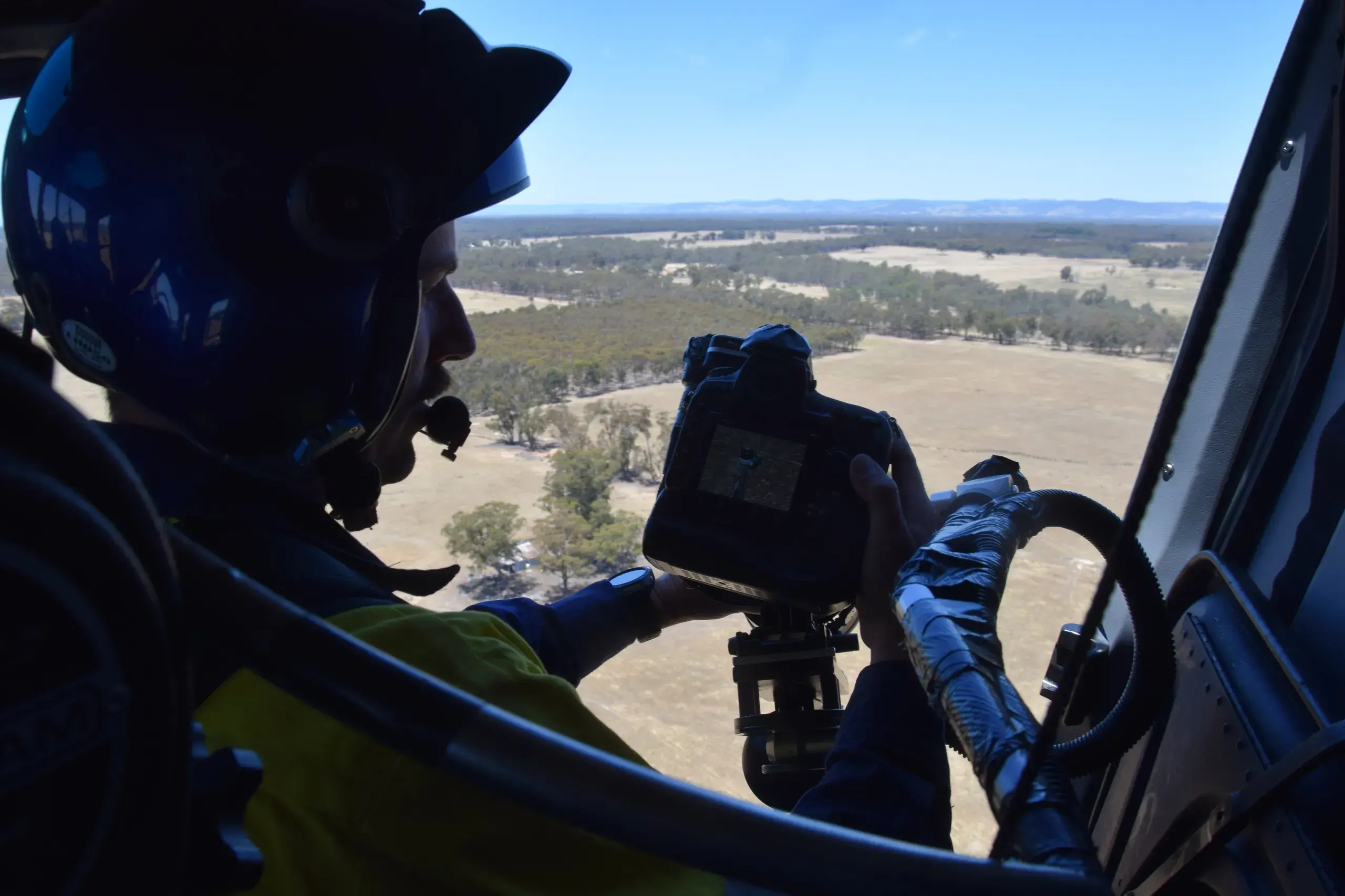
By ANDY WILSON “No one is in charge.” Barely comforting words for the uninitiated, yet when this correspondent mucked in with a three-man AusNet helicopter crew, the meaning behind the statement was assuring. Aerial operations coordination manager Gavan Doherty did not join the flight from Benalla Airport on Wednesday 3 December, but his thinking behind every one of his instructions made the best sense. “Everyone's sort of in charge; well, everyone works together,” he said while all my personal effects not pinned down to my body were taken from me for stowage. “And if someone's not happy, you put the helicopter down. “We don't take a risk, there's no risk-taking for us - we all go to work every day, and we all come home every night.” To that end, as part of the routine’s job safety assessment (JSA), emergency supplies with ration packs and SatNavs are checked along with the crew having the right maps loaded into their computer, are in the right area, that all communications are working, and the weather forecast reviewed. AusNet checks every one of their power poles across eastern and northeastern Victoria on a three-yearly cycle, averaging about 800 poles on any one of their days that comprises three two-hour shifts in the air. They have inspected and photographed 45,000 poles so far this year and are so efficient that they are one month ahead of schedule. The Energybird 350 is relatively new and the shine on its duco and decals makes the trip even slicker, somehow. I went on the 70-minute flight – my maiden on anything without fixed wings – with photographer Andy Swann, task specialist Troy Hampton, and pilot Matt ‘T-Bar’ Tomlinson. The professionalism on show with AusNet crews understandably starts well before ascent, well before I arrived in fact, and T-Bar gave me a thorough safety brief on the tarmac before I set foot inside the helicopter. The men take their careful time climbing into the craft and connecting all tethers, helmets and cables. “We will be going at about 350 to 400 feet,” Troy said as the liftoff started seamlessly – so gentle in fact, that I didn’t notice us moving as I was checking my waist tether for the fifth time. The Energybird is one of two that Gavan has on standby at any time and on Wednesday the other craft was at Moorabbin. The two helicopters can be deployed anywhere at any time – and quickly. Wednesday’s task was secondary to what these crews are trained to do, and they need to be on their A-game when they head into bushfires or areas after storms to determine damage to power lines as quickly and as closely to those lines as they can. However, even the more rudimentary task of inspecting poles still requires their A-game, and it is impressive to watch. Andy slid his door open and leant out with his two-foot-long, 400mm lens (with boost to make it effectively 600mm) as T-Bar slowed the helicopter and either hovered close to and well above a pole or circled around it. Andy quietly took a few shots, gave a verbal "yeah" and the Powerbird moved on. In the other front seat Troy entered the successful capture on two screens, one an iPad for backup, then T-Bar would carefully take us to the next pole either 100m or 15km away. This is a slick unit and the mechanism of the three cannot be disturbed. The mission is to take top images of all the poles which are then collated and assessed back at the office for any maintenance needs. Troy’s screen is comprehensive, drawing lines between each pole on the map as we journey and when Andy leant sideways to let me see the screen on the back of his camera, I could make out the wire coils around the pole’s insulators. Troy explained his role during a quiet leg of the trip. “I'll help guide and spot all safety observations for any animals, stock, hazardous wires, birds, and also help direct the pilot,” he said. T-Bar had no inclination to speak about anything except what was necessary to his crew. The AusNet helicopters also patrol snowfields in winter to keep those connections in tip top condition. “They are critical lines,” Gavan said before liftoff. “If we lose a major line there, we’re going to take an entire snowfield off the grid, and they are obviously a very important asset to keep on power.” We travelled over a range of landscapes, and above one paddock, T-Bar gave a gentle lap of a property to see if four horses feeding from a bale were going to be bothered by us. “They seem alright,” Andy said, snapping the picture of the pole that’s close to them. South of Euroa was our furthest point and one final pole on the way back needing to be photographed stood just outside the Euroa saleyards. Andy looked through his lens and gave a simple “nup”. The team take no time at all to decide that the tightly penned hundred or so cattle would create carnage if our proximity startled even one of them. “We will let that one go, for next time” Troy said. Benalla Airport soon approaches and within ten minutes we are landed, the rotors stopped, and the crew alight as slowly and meticulously as they had got onboard. Energy supply is a given in the 20th century, despite the challenges of the transition toward renewables and the climate events that threaten regional and rural areas. Service from energy companies or the foundational distributors such as AusNet (Victoria has four others across the state) is often limited to the shock energy bill in the post or the annoyance of random blackouts in storms or during fires. Knowing that a distributor as large as AusNet has at any time crews in the air on a quiet day maintaining their hardware's longevity, makes one wonders what these crews are like when it is a faster, lower operation that is more urgent. The answer comes not long after we land. "You can come out on one of those too when you're free."