PHOTO
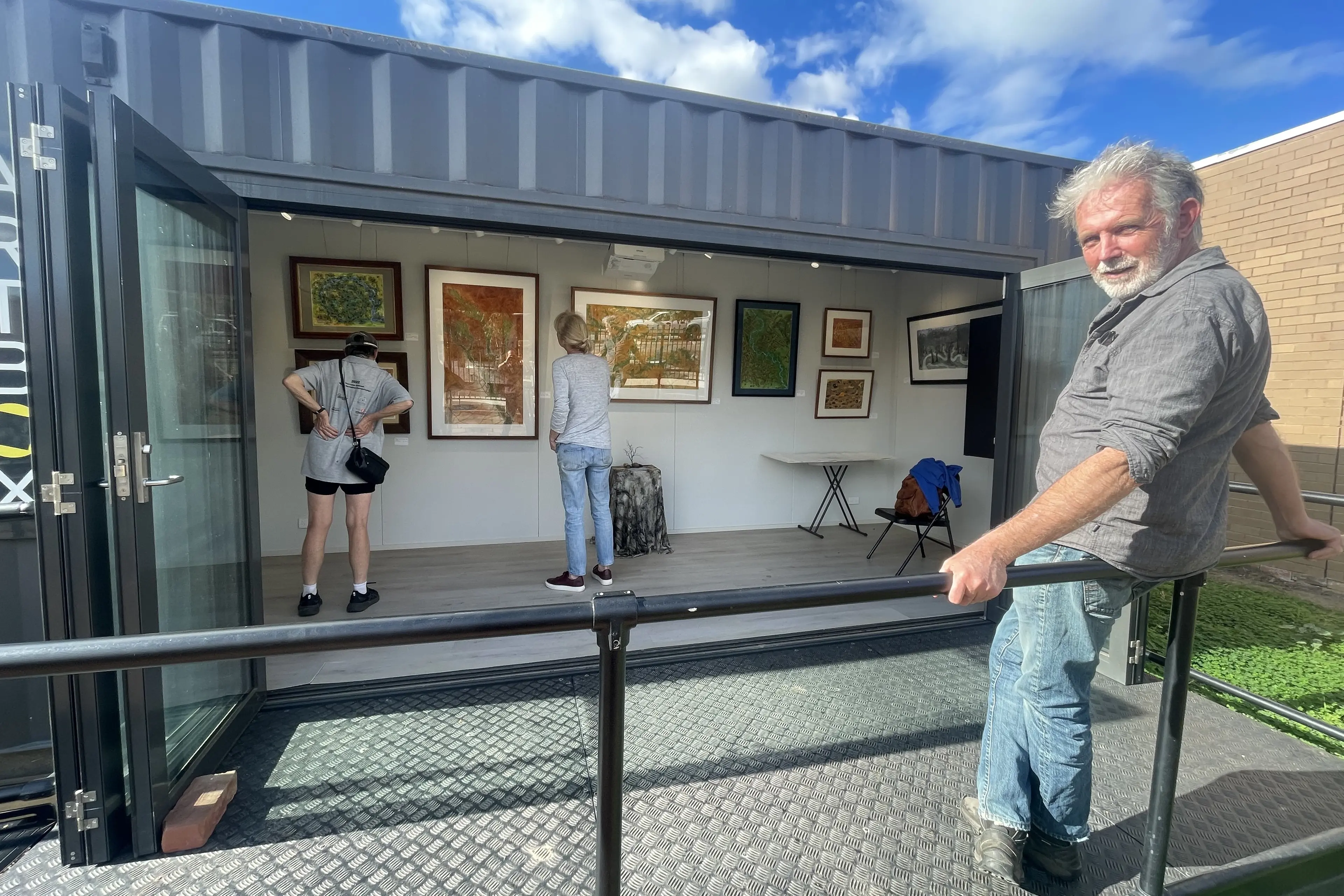
ARTBOX gallery has a way of becoming whatever you need it to be, and last week a chance encounter with Strathbogie artist Sim Ayres and part-time local Joy Sloan proved exactly that, the conversation threading the fine art on display into geography, nature, and finally some philosophy on world peace.
Strathbogie-based artist Simeon 'Sim' Ayres is exhibiting a range of his work in the now iconic mobile art gallery through the month of May in Binney Street, Euroa.
Ayres has built a quiet but growing reputation across northeast Victoria for work that interprets landscape through a deeply personal and almost cartographic lens.
Exhibiting widely and undertaking mapping commissions across the region, Ayres sits at the intersection of art, place, and lived experience — a practitioner grounded as much in terrain as in technique.
With a commissioned exhibition at the Shepparton Art Museum scheduled for 2027, his work has gained recognition as one of the region’s most distinctive and compelling creative voices.
Joy Sloan was viewing the works on Thursday and did not hesitate when asked for her impression of the exhibit.
She has seen something, felt something, and is trying to put language to it.
“I read the caption, read the title… yeah, it just - I don’t know - it just grabbed me,” she said.
“I have worked in that landscape realm, I suppose; I do environmental management myself.”
She talks of dry gullies and colour, but it is the vantage point that lingers - that characteristic aerial style of Ayres' work of looking down from on high.
"It's like mixing the sky with the earth type of thing.
“A really interesting interpretation just resonates with me, I suppose,” Joy says.
There is something in her reaction of a place felt rather than analysed that becomes a cascading conversation.
Joy has lived the landscape of the shire's flat country, its hill country, and Euroa in between.
“Dad was a soldier settler,” she says.
“So that (flat) side of town was all soldier settlement; Mum and Dad were the settlers out there.”
She said back then the land was divided, communities separate, distances greater, and only in recent years has she really had time to return to it with fresh eyes.
“And you can poke into different areas and think 'oh my God, this is so good'.”
Ayres doesn’t speak like an artist trying to impress, despite the movie-star looks, calm demeanour, and charismatic style.
Asked to summarise his work in a single word, he laughs.
“Someone said it before - geomorphology,” a word he admits is new to him.
“I’ve only learned that word today - I’ll have to go look it up.”
For someone whose work so clearly maps terrain, the moment feels almost perfect as a reminder that curiosity sits at the centre of the practice.
He settles on the simple: “I would describe myself as a mapmaker.”
His pen and ink works are complemented by his use of watercolour, with lines that are about movement, memory, and form.
Joy, meanwhile, relates the art to this year's bushfires.
“When fires go through, and people say the world has ended, within weeks the bush answers back," she says.
“Tree ferns starting to sprout, grass trees starting to sprout, little rock ferns come up.
“The world hasn’t ended but it’s had a huge hiccup - and it’s survived.”
Ayres nods along as the artist and the ecologist align.
Nature, both seem to suggest, is not quite as fragile as we like to declare.
Conversation drifts to the ‘Anthropocene’ - the now-fashionable term for an age defined by human impact.
“It means we’re living in the age of extinction,” Ayres says.
“But if you announced that to a tree that’s 400 years old… imagine if the tree could hear you say that.
"It would say 'you what?' Who’s living in an Anthropocene?”
He is not dismissing the science. But he is wary of the tone and suspicious of easy conclusions.
As the conversation drifts on, Joy's suggestion of a further world war is met with a philosophical angle from Ayres.
“It might be true that we might be living on the precipice of total obliteration but I think it’s a matter of style not to speak so negatively,” he said.
Not degradingly, as he puts it in a subtle but telling distinction.
That philosophical edge emerges almost casually, but lingers longest.
“I think you do tempt fate by what you say,” Ayres said, turning a single word over in his hands.
“When you speak the word ‘spell’, as in spelling something out, is the same as casting a spell into the world.”
It is said lightly, but not without weight.
“So we have to be careful what we say.”
In a world inclined to declare endings, catastrophes, and finalities, Ayres offers something quieter and perhaps more difficult.
Care with language. Care with conclusions.
Simple as that.