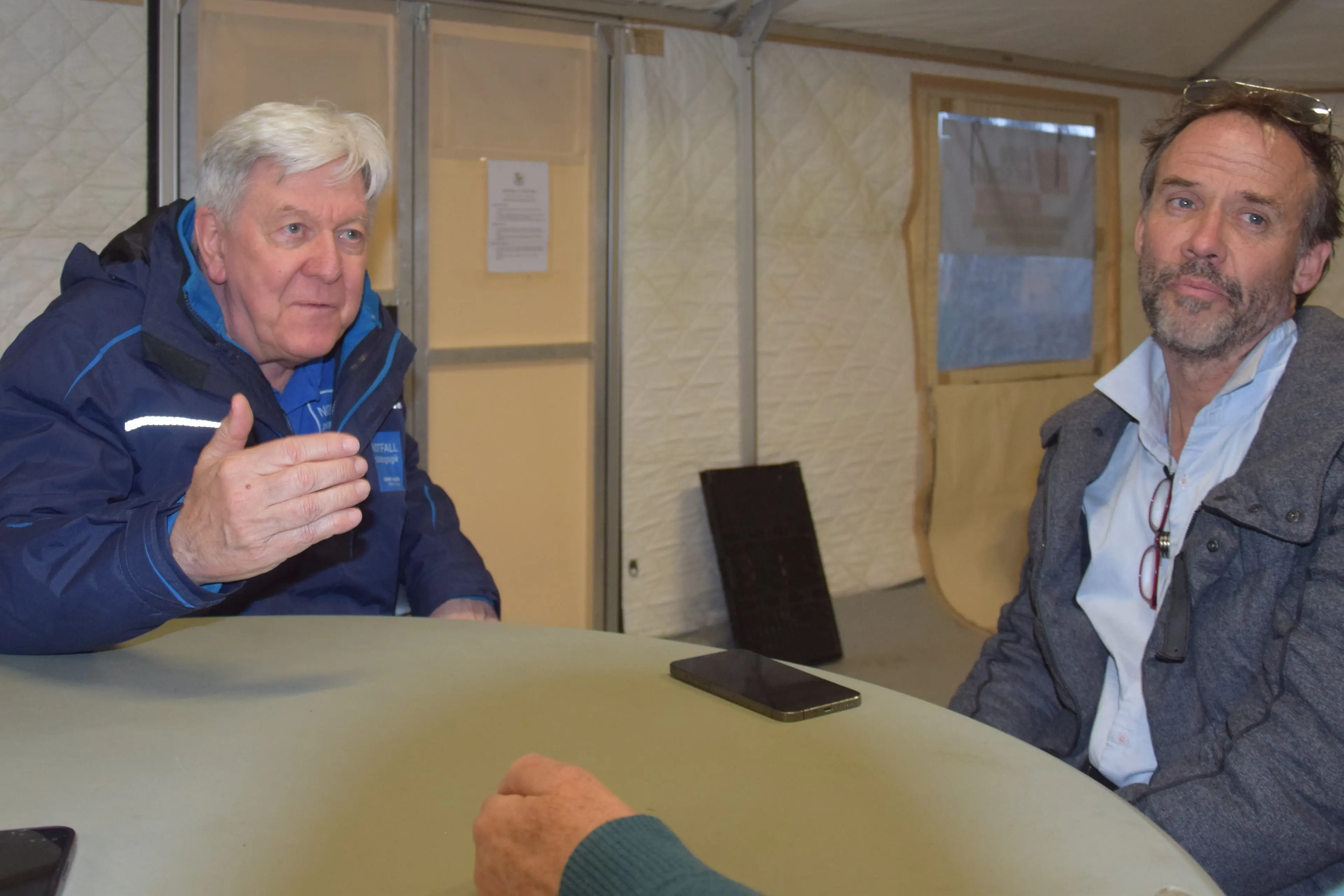
In terms of trauma recovery, Bernd Ruf has an expertise in treatment that is as unique as it is simple, effective, and science based.

Ruf flew from Germany last week to visit the Ruffy Community Hall for several sessions of his Emergency Pedagogy Without Borders program on Friday 10 April and the following day, a program run by certificate-trained volunteers who travelled from across the eastern states to donate their time.

Ruf works as a teacher in Steiner (Waldorf in US) education in Karlsruhe, outside of Straßberg, and in 2006 founded Emergency Pedagogy Without Borders in response to the war in Lebanon, focusing on children impacted by that conflict.

Since then, the group has visited most natural disasters immediately after they occur anywhere in the world as well as US schools after mass shootings.

They reached Bondi a few days after the tragic Hanukkah shootings on 14 December.

Ruf has not attended all disaster and tragedy interventions but has been the leader for 150 of them all over the world.

The methodology used in the program has naturally widened to include adults, such that families were encouraged to partake in the sessions and did so on both Friday and Saturday.

This correspondent partook in Saturday morning’s session in the hands of Matthias Engel and Deborah Neale and their team, having the night before interviewed Bernd Ruf.

The Saturday session was non-confrontational, had no requirements for participants to speak (activities mostly done in silence), used creative methods that were simple but not childish, and allowed anyone to step out of an activity if they wished.

Such is Ruf’s insistence and passion for telling people why they needed to act within six months of any disaster – a clinical reality published by the World Health Organisation – he chose to use a translator.

Ruf’s English is quite sound, but he wanted more clarity by having the freedom to speak in his native language.

The Euroa Gazette has chosen to publish his words as translated by Lisa Devine, a registered psychologist who works under the supervision of Dr Rob Gordon, who has also spoken at Ruffy and other impacted communities.

EG: How did you fare with the language barrier with Lebanese children?

BR: Language does not play much of a role in emergency pedagogy.

EG: Why not?

BR: The methods that we use don't really need language, for example painting, singing, movement, and we always work together with local experts.

So, the teachers at the schools, for example, can mostly speak English, so that we can then speak in English and (they) translate it to the children.

EG: So, when you draw on local staff, is it based on Steiner schools?

BR: No, these interventions can take place anywhere - it has nothing to do with Waldorf schools; we have the Waldorf and the Steiner schools, of course, as cooperation partners, if there is such a thing in the country.

But the Steiner methods we use include what every child does – painting, drawing, singing, every child can sing – every child.

EG: How does it work when you arrive after a major event?

BR: We always need people who support us on site.

If we go to a catastrophe, we can't just turn up and say ‘here we are’, (but) you need local connections who provide the entry point for the work.

Steiner schools are very useful (for that), but we don't need local Steiner teachers to do the work.

There are different methods, but the first one is you see it with your eyes - reading the children.

If you come to the intervention, everybody sees it on the children and in the adults, actually.

You can see it right in front of your eyes; most of the children are very tense in their facial muscles, the eyes are very wide open, shocked.

And when the trauma is very bad, sometimes you can't see any light from the eyes at all, and if you work with the children in this way, just after a day, that releases.

And it is something that everybody sees, even those who don't know anything about the world of pedagogy, they see it directly.

That's the first thing.

EG: What is the academic, clinical background to the methods used?

BR: There are studies being done, evaluations from universities, from governments; many in Gaza, in the refugee camps in Kakuma [Kenya] and at the University of Colombia.

Children that are impacted have been scientifically studied.

EG: Many local people who have been traumatized would not have been here today and might not come. What would you say to them?

BR: Normally after a trauma life is never the same again, it's not the same as it was before, and they suffer a lot, and it's normal after a trauma that any kind of working with the trauma, they actually push it away.

They avoid talking about the trauma, working with the trauma, coming to something about the trauma.

Because it hurts.

The problem is, if you don't engage with it, you cannot heal it.

And when people's forces aren't enough to work it through themselves, it leads to illnesses either in the soul or in the body.

At the beginning of a trauma there's a lot of symptoms, and really a lot depends upon what kind of resilience forces that they have and how they can actually work with these symptoms.

Not everybody becomes ill; and symptoms can disappear after a while, but if they don't disappear after a certain time, then you don't describe it as a trauma reaction to a terrible experience anymore, but as a diagnosable illness.

That's the danger that exists.

The science that farmers need to know

Deborah Neale is the managing director of Emergency Pedagogy Without Borders and provided this masthead with the science of how the creative treatment repairs significant damage to the brain after trauma.

She also outlined how the creative methods of the sessions related ‘so strongly’ to farmers and their decision making.

“We aim to help the person work through the experience of the trauma so that there is self-healing,” she said.

“And you've got about a half a year, six months, to do that.

“At the sessions, we do not talk about the trauma, but give time and space to stop and relax.

“They are creative workshops that support those affected.”

Deborah explained the neurological (brain structure) behind trauma.

“The neocortex – which is where your executive functions tick – holds all the things that make us humans, to allow us to dance and sing and make things.

“It’s the creative part of the brain.

“What people don’t always realise is that farmers need to be creative in their decision making.

“With trauma, the neocortex shuts down, and in the reactionary phase, the reptilian brain takes over, which is fight, flight, or freeze.

“The neocortex is a lot of different roadways of ways of thinking: your language, your creativity and even your balance.

“Those roadways get physically blocked because you don’t have access to them when you’re in shock.

“In humans, they can get stuck there, and you have a six-month window to reopen all those pathways as soon as possible or get stuck in reptilian mode.

“Farmers need to be creative, so they need to address this.

“The seasons change, the markets change, there is so much that requires creativity with every task a farmer undertakes.”