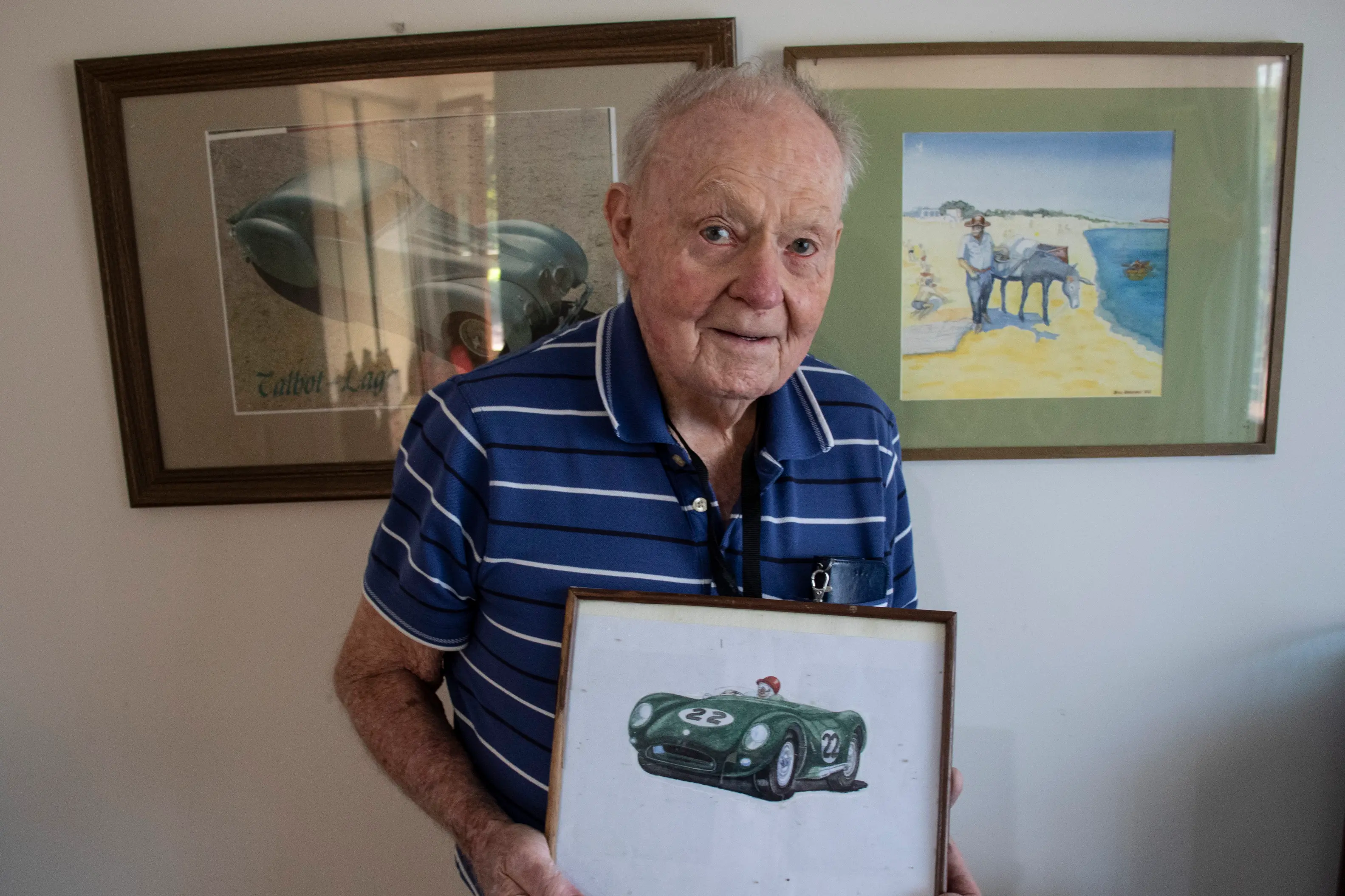
There is a moment early in this story where a good idea quietly and quickly becomes something much bigger, ending up as a popular annual event now in its 49th year. The Historic Winton races will be held on the weekend of 30–31 May at the Winton Motor Raceway, an event which has behind it a history that comes down to one man from Euroa who had an idea. Bill Sheehan had tired of watching a messy grid of old cars trying to find their place on the track. “We used to run historic cars as support races,” Bill said over a coffee on Wednesday 13 May. “They were all mixed in together — a bit of a butcher’s picnic.” The cars were there, the drivers were there, but the idea wasn’t — not yet. That arrived out of Sydney in the mid-1970s, when a group of enthusiasts decided to strip things back and run a meeting made entirely of historic cars. “They booked (Sydney's) Amaroo Park for Australia Day,” Bill said. “Then they realised there were too many other events on and that they mightn't get a crowd to pay for the circuit.” The solution was simple enough: broaden it. Motorcycles were invited. The numbers followed. The idea held. And for Bill, that was enough. “That was when I thought — we’ve got to have one of these in every state.” Getting from idea to track, however, had required more than enthusiasm. The Vintage Sports Car Club in Melbourne passed on the idea — not through lack of interest, but because they wanted their members racing, not organising. Bill took it elsewhere. “I talked the Austin Seven Club into backing it,” he said. “I talked them into outlaying a big bag of money to pay for the first meeting.” What followed was a gamble: a club committing serious money to hire a circuit, build an event from scratch, and hope enough people would turn up — competitors and spectators alike — to make it work. The choice of venue was Winton, partly for practical reasons. It was a tight circuit, better suited to older cars, and it was forgiving, too — if things went wrong, there was more runoff space to avoid drivers destroying the irreplaceable. Perhaps the choice was also for more personal reasons. “I’d done my schooling in Benalla,” Bill said, confessing to a small but useful bias. The plan’s execution then faced its first challenge. “The trouble was there was a postal strike,” Bill said, and with no mail service, every competitor had to be contacted by phone — spoken to, convinced, entered, and confirmed without paperwork, meaning that the first Historic Winton in 1977 became an event built one conversation at a time. Another challenge then cropped up, this time from the top brass. “The governing body limited us to 17 cars on the track,” Bill said. “I thought that was ridiculous.” Although it took some years for those limits to change — first to 23 cars, then eventually to full fields of 40 — in that first year it was enough. For Bill, ‘historic’ was never just about that class of car which was defined as being pre-Second World War with some specific models after that. He traces the local racing history back to Easter 1936, when a 100-mile (161km) road race was held in Benalla at a time when racing on public roads was illegal. Somehow, the local constabulary was coaxed to divert traffic and help manage the crowd of about 20,000 at what was the mainland’s first ever road race run by the Victorian Sporting Car Club. “It was raced down one road and then out onto the aerodrome,” he said. “That’s what made the area historic for racing for me.” Four decades after that first race, the 1977 event’s name came easily and was registered quickly for the first meeting. Away from the track, Bill’s path to that moment had not been direct. He began in the railways as a junior clerk, moved into private industry with Caterpillar dealers, and later studied advertising at university. At 40, he changed direction again. “That’s when I started restoring cars,” he said. Over the next three decades, more than 200 Austin Sevens passed through his hands along with a range of other makes, either restored or built by him, including lightweight racing versions of Austin Sevens with aluminium bodies and their distinctive boat tails. “They weren’t just road cars anymore,” he said. Some of those cars are still in use today. Racing formed part of the story, though not always in the way expected. Bill held a national racing licence into the early 1980s and often drove cars owned by others and kept a clean record. “I used to get asked by other people to race their car for them,” he said. “I never damaged or blew up anybody else's car, because I didn't want to have to pay to rebuild it.” He pauses. “That’s probably the reason why I finished down midfield all the time.” One opportunity stood out when he was asked to race Tarcisio (Terry) Valmorbida’s 1948 Maserati at Phillip Island — a car that in its time was at the highest level of the sport, the equivalent of being asked to take a Formula One car for a spin today. “That was my highlight, but my lowlight was that the bloody Italian mechanics couldn't get it to go, and I spent the whole weekend being towed around the pits, trying to get it started. “Meanwhile my racing Austin Seven I'd loaned to a young bloke, and he was out racing it at Phillip Island.” A bit of a Renaissance man soon emerges, with Bill confessing that he represented Victoria in veteran table tennis for more than 30 years. He also built a quiet reputation as an artist, with watercolours held in collections across five countries and illustrations published in car magazines. During all this time Historic Winton continued to grow. More categories were introduced, more competitors travelled from interstate, and the meeting became a fixture on the motorsport calendar. Bill stepped away from organising after the first two years but remained involved for decades, later taking on the role of commentator, something he only stopped in recent years. “I was worried that I'd start to forget names, which you can't afford to do when you're spruiking,” he said. Now approaching its 50th year, Historic Winton is firmly established, and what began as an idea prompted by a crowded grid and a better way of doing things has become one of the country’s enduring historic racing events. Bill does not talk about legacy – he talks about circuits, cars, and the people who helped make it work. But the result is clear enough, that an idea taken seriously was followed through. And is still running.