
PHOTO
A Euroa transport company is helping test what could be the future of long-distance freight, with one of Australia's first long-range electric prime movers spending time on local roads.
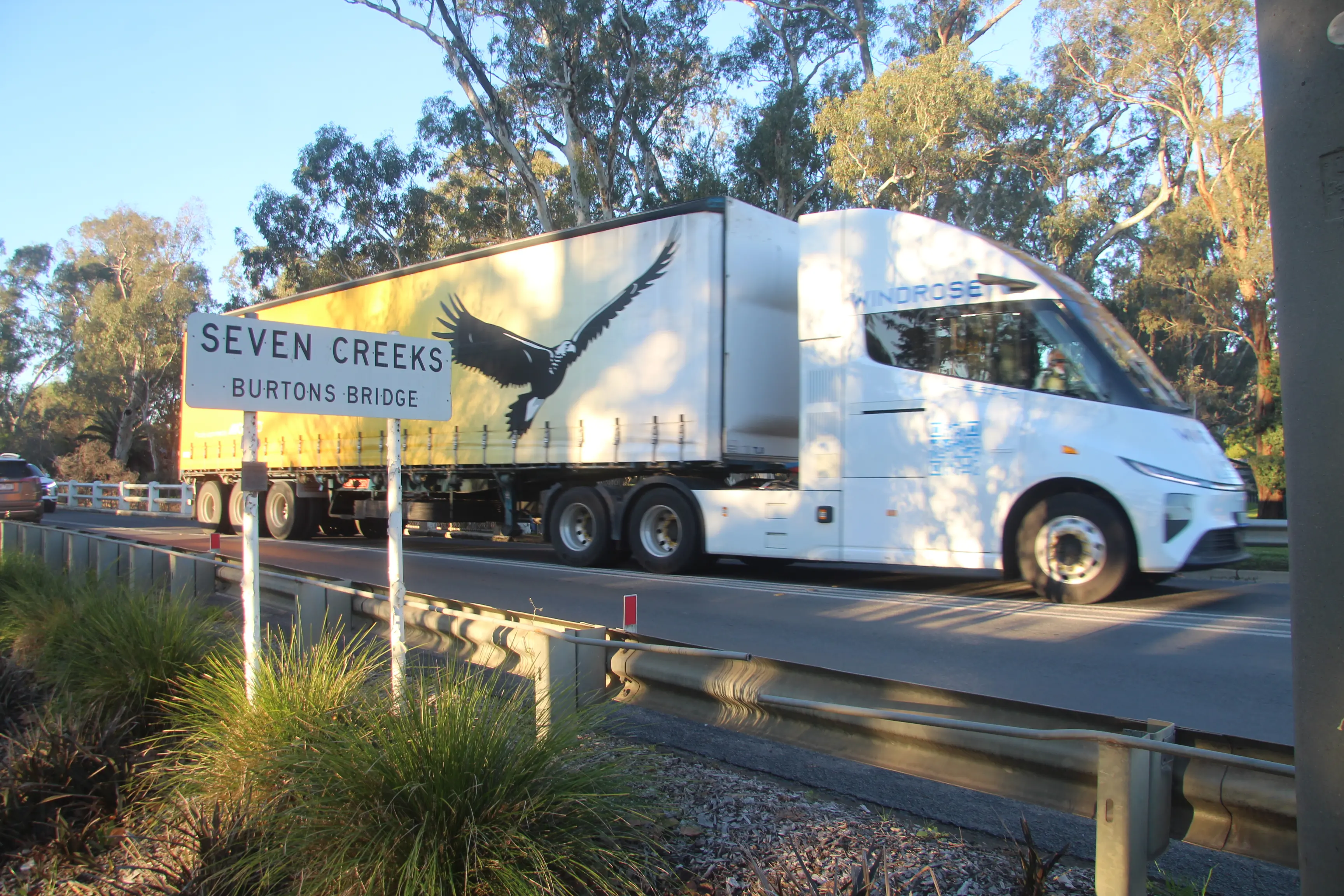
Brady & Kibble Pty Ltd has been trialling a Windrose E700 electric truck, a Chinese-built vehicle capable of hauling freight between regional Victoria and Melbourne, a task traditionally performed by diesel-powered trucks.
The demonstration vehicle, which features a central driving position and styling inspired by Tesla, has generated significant interest since arriving in Euroa.
Company co-owner Shirley Saywell said the industry was at the beginning of a major technological shift and regional operators needed to be involved in shaping it.
"For me, it's the future - it's coming our way," Ms Saywell said.
"We want to be first on board because we need early adopters.
"If our drivers can drive it and find things they like about it, and of course there are things that can be improved, we can make this happen across the board."
The Windrose company itself is only four years old, something Ms Saywell said made the truck's arrival even more remarkable.
"In four years they've brought a truck to market from absolute scratch," she said.
"I thought I would be 90 before one would come to Australia, and now it's here."
Although the manufacturer claims a range of about 700km, Ms Saywell is more conservative.
"We're saying it's around 500km in real conditions," she said.
"Because we're loaded both ways and operating at weight."
While exact carbon savings depend on route, payload, and charging source, a comparable diesel prime mover can emit around one kilogram of carbon dioxide per kilometre travelled.
Based on the Windrose E700's reported real-world range of 480-500km, a trip of that distance could avoid roughly half a tonne of tailpipe carbon emissions per trip compared with a conventional diesel truck.
While several electric truck models are available internationally, Ms Saywell believes the E700 is among the first currently operating in Australia capable of reliably servicing longer regional freight routes.
"There are electric trucks around, but they're mainly doing what they call 'the last mile'," she said.
"We need something that can go from regional Victoria to Melbourne and back."
That range is sufficient for much of the company's work between Euroa and Melbourne.
The truck is currently being evaluated by veteran driver Jason Mullenger, who has spent more than three decades behind the wheel of heavy vehicles.
This correspondent was the first non-company passenger to ride in the cabin on a lap of Euroa on Thursday afternoon, with Mr Mullenger seated at the wheel inside the spacious, futuristic cabin.
"It's nice to drive and it goes, it really goes," he said, demonstrating the vehicle's zip with a tap of the accelerator.
"I suppose this is the way of the future, although I prefer driving what I call a real truck."
Replacing traditional side mirrors are two screens fed by external cameras.
Another unique feature is a loud voice that broadcasts outside the vehicle when it reverses or turns.
"That's because people - both pedestrians and drivers in other cars - won't hear the noise of a loud truck as it nears them, so a voice warning is what they have come up with."
A further advantage is the regenerative braking system.
"When you take your foot off the accelerator, it engages the retarder and the regenerator," Mr Mullenger said.
"So it slows the vehicle without using the brakes and recharges the battery as well.
"Every little bit of charge helps."
Despite concerns about the cost of electric vehicles, the truck's purchase price is comparable to a conventional diesel prime mover.
"It's around $500,000," Ms Saywell said.
"That's the same price as a similar-sized Kenworth."
The conversation naturally turned to the environmental benefits of electric vehicles, which Ms Saywell said remained front of mind.
"It's easy to get distracted and only talk about the truck's economic impact," she said.
"And of course that's why we're doing this; I have wanted to get off diesel for a long time, because we know the true cost of diesel extends far beyond the pump.
"It is incredibly exciting to witness this tipping point, where clean energy is now both the ethical choice and the smart financial choice.
"That makes me incredibly happy."
One of the biggest challenges remains charging infrastructure, with the truck currently relying at times on passenger-vehicle charging stations.
Ms Saywell said dedicated truck-charging infrastructure would be essential if electric freight was to become mainstream and that charging technology was already advancing rapidly.
"Truck chargers will be way quicker than a car one," she said.
"The charging system is being built as we speak."
Alongside the transport benefits, Ms Saywell believes electric trucks could eventually play a role in regional energy security.
The company is exploring opportunities with organisations including AusNet, the Australian Renewable Energy Agency, and charging specialists to investigate how large vehicle batteries might help communities better utilise excess solar generation.
Future developments could allow trucks to store excess solar energy generated during the middle of the day and potentially feed power back into local networks when needed.
"This thing has got a bigger battery than anything in Euroa," she said.
"It's opened up a whole new way of looking at transport and energy."
For now, however, the focus remains firmly on learning what works and preparing for change.
"We've been talking about electric trucks for a long time," Ms Saywell said.
"It's moving incredibly quickly, and people don't realise they're already here."
FAST FACTS - Windrose E700
Long-range electric prime mover
Manufacturer claim: about 700km range
Real-world estimate by operators: 480-500km
1400hp
Payload: 68 ton
Approximate price: $500,000
Central driving position in cab
Able to service regional Victoria-Melbourne freight routes
Trial vehicle currently operating with Kibble & Brady P/L in Euroa