
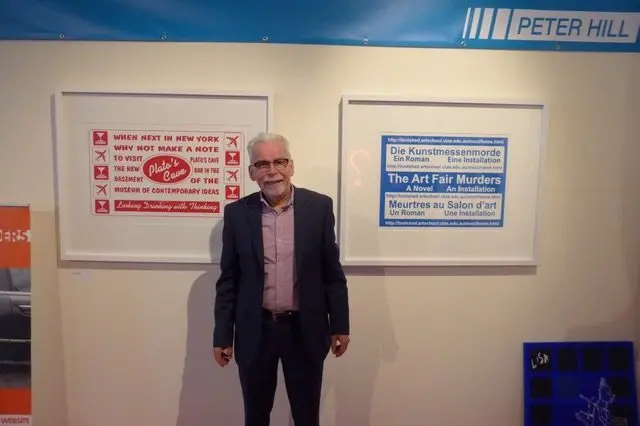
PHOTO
PETER Hill, freshly arrived to Euroa from Melbourne a few months back, and originally from Glasgow has lived his life through art which questions the reality of just about everything.
His ongoing exhibition – which began in the mid 1990s – questions the culture of fake news and is titles "Fake news and superfictions".
"It has travelled the world with his creator and was supposed to tour in the USA during Donald Trump's second campaign in order to question his always very disputed speeches, but COVID–19 put a stop to it," Dr Hill said.
However, Dr Hill's lifelong work is already recognised in America as Professor Antoinette LaFarge at University of California, Irvine, published last month a book called Sting in the Tale: Art, Hoax, and Protest (DoppelHouse Press) that has about 40 references to Dr Hill's Fake news and superfiction in it.
Dr Hill is quite happy about it and hopes his American tour will be facilitated by Dr LaFarge.
"I'm aiming to get to America, and go on a lecture tour from California to Chicago, New York and then come back through Canada from Vancouver through Toronto," Dr Hill said.
"Antoinette said she will help arrange residences and lectures."
Dr Hill, who is also a writer, and independent curator and an Honorary Enterprise Professor at the VCA, University of Melbourne, made the acquaintance of Dr LaFarge as she was researching for her book and thus read Dr Hill's PhD, published by RMIT University in 2001.
Dr Lafarge writes in her book that Dr Hill's PhD is the first major work to define how fictional situations have been introduced into contemporary art spaces.
"Scottish–Australian artist Peter Hill, who wrote the first lengthy treatment of fictive art (or "superfictions," to use his preferred term), has been inventing fictive entities at least since the 1970s," Dr LaFarge writes in her book, where she also refers to another of Dr Hill's artwork, the Museum of Contemporary Ideas.
This artwork is a façade of an entire museum rather inexpensively through fictional press releases imagined by Dr Hill, through which he also staged fictional art fairs.
Dr Hill and Dr LaFarge are aiming to organize a blog and a podcast about "Fake news and superfictions", a theme which resonates with our era, filled with social media and their alternative and curated reality.
"My Art Fair Murders project is on–going and began in 1995," Dr Hill said.
"It has been shown in many museums around the world – MCA Sydney (Biennale of Sydney); Museum of Modern Art (Oxford, UK); Auckland City Gallery, ACCA Melbourne.
"It exists in the gap between installation art and literary fiction and speculates on a serial killer being loose in the artworld killing one person each month at a different art fair around the world during 1989, the great year of revolutions."
The artist would also like to arrange exhibition around the region.
"With my work, I'll be approaching also smaller galleries like Shepperton and Benalla; I have to go on to it."
Dr Hill has already teken his art all over Europe and even exhibited it in Venice during the last Biennale, during which he rented a Palazzo to exhibit it.
"The message I want to say with my art is how do we tell visually what's true and what's false in the world; there is also a philosophical and scientific aspects in this as authors Karl Popper and Thomas Kuhn proved, who have very sophisticated ways of working out what's true and false, and ideas of falsificationism," he said.
Dr Hill also recently created a fictional avatar – "a bit like Banksy did – called Stickleback, through whom he created around 60 artworks, once again questioning the identity and the reality of the artists behind their work.
Stickleback's 1m x 1m paintings – already dubbed The Tasmania Suite – take their inspiration from 2020's protest banners and placards, newspaper headlines, religious texts, art–historical quotations, and a range of contemporary and historical artists.
"I've made over 60 paintings during lockdown," Dr Hill said.
"They are mostly about environmental issues, black lives matter, gender issues, aboriginal deaths in custody inspired by the black and white placards people use at demonstrations.
"I will try and get exhibitions of Stickleback's work across America and Canada when I go on lecture tour."
Stickleback's work has been exhibited at the documanta, the Sydney Biennale, and the Geelong Art Prize among others.