
PHOTO
Over 70 concerned residents gathered in Euroa this week for a public forum on the town's ongoing electricity reliability problems, with local, state, and federal leaders joining AusNet representatives to discuss possible solutions and hear first-hand the community's frustrations.
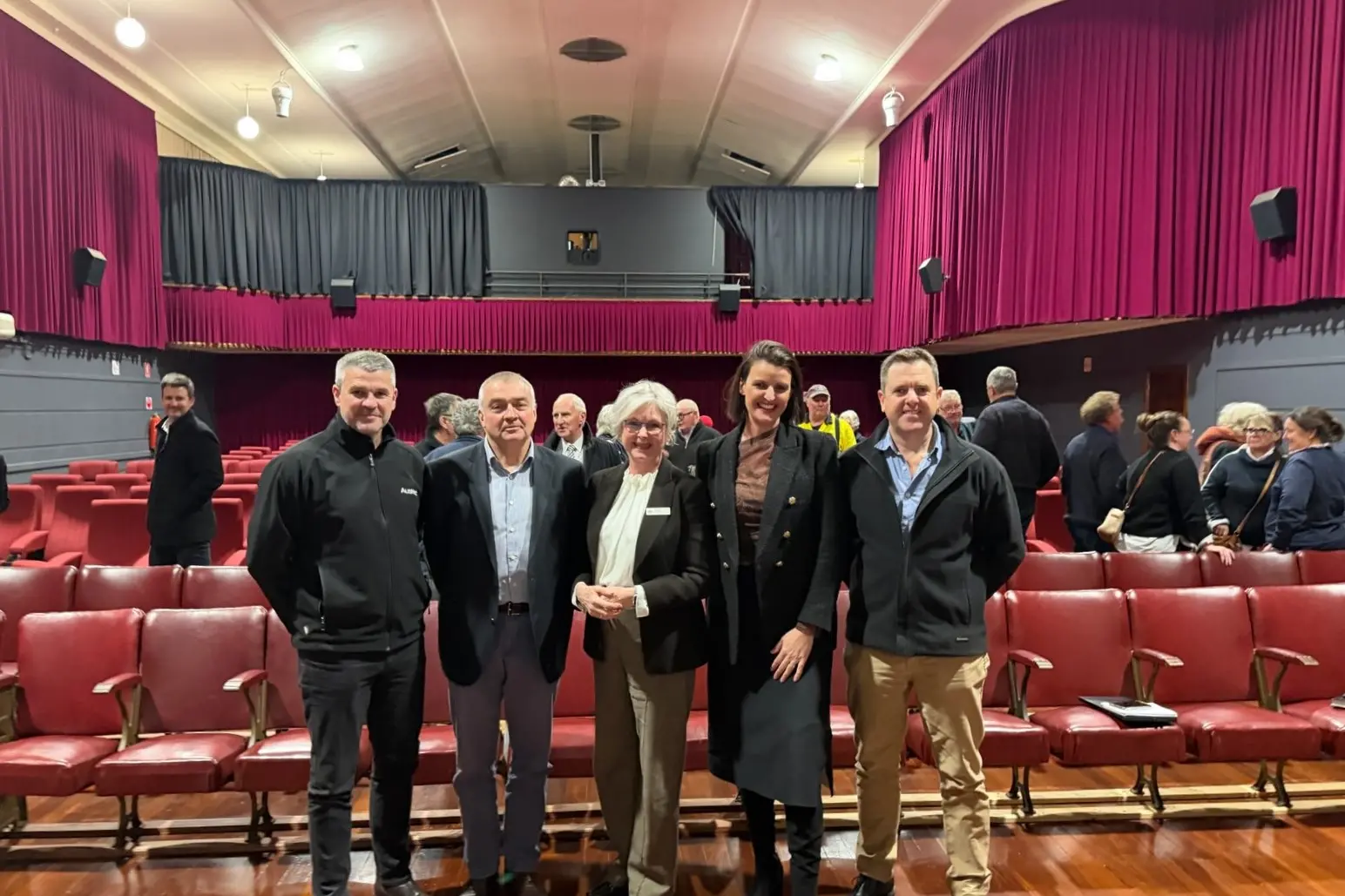
Hosted by Strathbogie Shire Council, the meeting brought together Mayor Scott Jeffery, Federal Member for Indi Helen Haines, State Member for Euroa Annabelle Cleeland, and senior AusNet executives, including executive general manager of distribution Andrew Linney.
The panel discussion was facilitated by Lachie McKinnon, chair of the Strathbogie–Benalla Community Group.
Opening the meeting, Cr Jeffery said reliable electricity should not be a luxury for a community located 90 minutes from Melbourne.
"We're all here because we're sick of being left in the dark," he said.
"Our community has endured repeated outages and rolling brownouts for far too long.
"These disruptions affect everyone - farmers who rely on electricity to water stock, small businesses losing fridges of spoiled food, households, elderly residents, and families with young children who worry every time the power goes out."
Cr Jeffery said council had advocated for almost a decade for major upgrades to the local network, including AusNet's proposed $38 million BN11 express feeder, which was recently rejected by the Australian Energy Regulator (AER).
"To say we were disappointed is an understatement," he said.
"This project would have provided the essential power redundancy our communities need."
The AER approved $5.7 million for covered conductors as an alternative to the BN11, a solution council believes will not adequately address the problem.
Dr Haines described the issue as one affecting not only convenience but public safety, particularly during bushfires and extreme heat.
She said unreliable power compromised emergency communications, affected businesses, and placed elderly residents and young families at risk.
“Over many years, I’ve heard from locals in Euroa about the real impacts being caused by unreliable energy - from elderly residents being left without heating or cooling, to families facing the cost of replacing spoiled food, and businesses scrambling to protect their stock," Dr Haines said.
“During the recent bushfires, residents also raised concerns about losing access to important emergency information when power outages also affected telecommunications.
“The recent decision that a new feeder line from Benalla to Euroa will not be funded was a major disappointment for this community; but the work does not stop here."
Dr Haines outlined her ongoing advocacy in Canberra, including raising the issue in Parliament, submitting the BN11 feeder proposal through her budget submission process, and meeting directly with the AER following its decision.
Member for Euroa Annabelle Cleeland said power reliability had been one of her highest priorities since entering parliament more than three years ago and said the outages during the summer of 2023–24 resulted in hospitals relying on generators, fuel stations running low on diesel, and telecommunications repeatedly failing.
Ms Cleeland argued that the AER's assessment process disadvantaged regional communities because it did not adequately account for population growth, geography, economic opportunity, or public safety.
Ms Cleeland also made her position clear on renewable energy.
"New energy sources may well be part of this region's future, and there may be benefit in that down the track," she said.
"But right now, we do not have the infrastructure to support it, and this community cannot afford to wait another ten years while that gets sorted out.
"The challenge in front of us today is capacity and infrastructure."
She confirmed she was pursuing alternative funding pathways with the state government while AusNet developed its revised proposal.
Mr Linney explained the technical challenges facing the region.
The BN11 feeder, stretching approximately 1200 kilometres and supplying around 5000 customers, is the largest distribution feeder in Victoria, and because electricity flowed from Benalla along a single extensive feeder, faults anywhere on the line could interrupt supply to large areas downstream.
Mr Linney said vegetation, lightning, wildlife, ageing infrastructure, and bushfire protection technology all contributed to outages.
While acknowledging community disappointment following the AER's rejection of the express feeder proposal, he said AusNet remained committed to improving reliability and would invest the approved $5.7 million entirely within the local network.
He said engineers were now examining alternative options, including reducing the size of the BN11 feeder through additional network connections, improving fault detection technology, installing more intelligent switching equipment, and investigating local microgrids.
He also argued that Australia's current regulatory framework, which operated on five-year funding cycles, no longer reflected modern electricity use or the needs of regional communities.
Dr Haines said one of her priorities following the meeting would be to continue challenging the AER's decision-making framework to ensure regional communities received fairer consideration.
“I’ll continue working with AusNet, the council, and all levels of government to deliver better energy security for Euroa and surrounding communities,” she said.
While no immediate solution emerged from the forum, the evening demonstrated a united commitment from the community, AusNet, and all three levels of government to continue pressing for both short-term reliability improvements and longer-term investment in the infrastructure needed to secure Euroa's electricity supply.
Residents unable to ask questions are invited to submit them to Strathbogie Shire Council for referral to the appropriate panel members.
Vox populi
Community members contributed a wide range of questions and suggestions during the forum.
Norm Scholes, representing the Renewable Avenel Energy Group, questioned the five-year regulatory cycle and said it failed to recognise the rapid growth potential of regional communities.
He also argued that the approved funding would deliver only limited improvements.
Mark Tame from Strathbogie suggested investigating a local gas-fired power plant as another option for improving supply reliability and said there were similar arrangements in Laverton and Craigieburn.
Shirley Saywell, owner of Brady & Kibble Transport, urged the community to continue supporting renewable energy solutions and asked whether council had engaged with wind farm proponents.
Strathbogie Shire CEO Rachelle Quattrocchi said such projects formed part of a longer-term strategy and that council had been in discussions with AusNet and both members of parliament.
Greg Prichard, resident of Caveat and chair of the Strathbogie Responsible Renewables Community Group, cautioned against viewing the proposed wind farm as a quick solution, saying there remained significant community concerns and that the project was still some years from completion.
Strathbogie Shire Councillor Clark Holloway, speaking as a Strathbogie resident, questioned whether the AER could allow infrastructure projects to proceed where funding came from independent or public-private sources rather than electricity consumers.
Mr Linney said there was also a mechanism outside the AER's normal approval process, known as a licence condition, which allowed the government to direct AusNet to undertake specific network projects outside the usual regulatory funding framework.
Speaking on behalf of Renewable Avenel Energy, Jim Billings shared his experience of losing his home during the bushfires after being unable to defend it because his water supply depended on electricity.
He called for greater emphasis on community resilience, including backup power for emergency refuges and essential facilities while long-term network upgrades were pursued.
Euroa resident Wendy Greenwood inquired whether AusNet and government representatives had examined national and international examples of best practice in electricity regulation and network management.
Mr Linney said AusNet continued to study approaches used in Australia, the United Kingdom, and the United States while trialling new technologies designed to locate and isolate faults more quickly.