
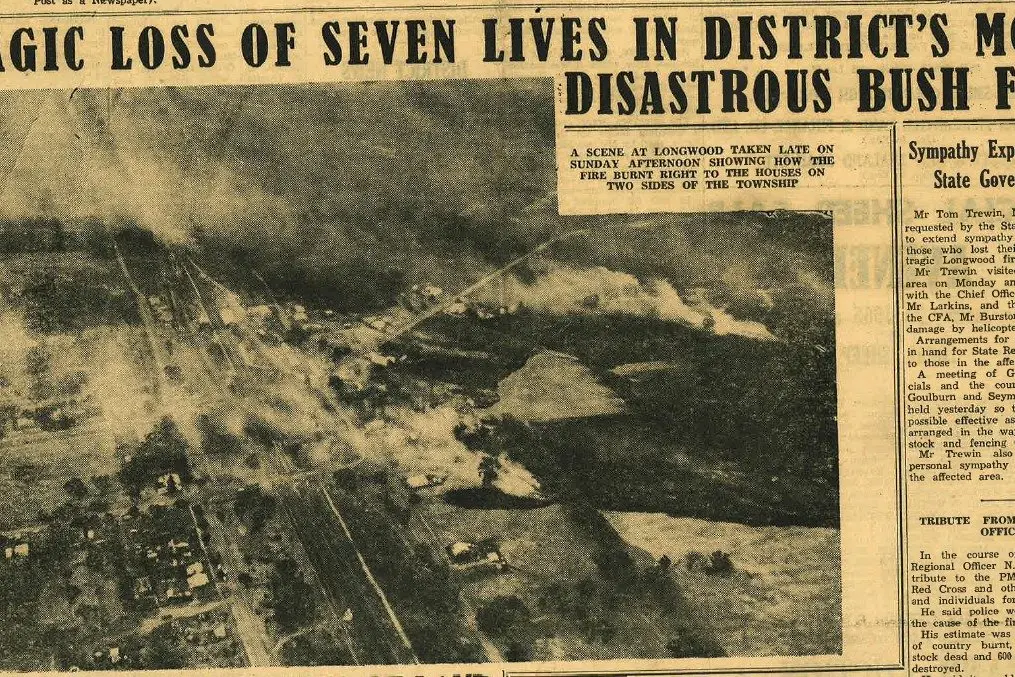
PHOTO
This personal account remembering the 1965 Longwood bushfire tragedy was first published by The Euroa Gazette in January 2015.
It has been reprinted as the 60th anniversary of the tragedy approaches.
By JANE RANKEN, with Bill and Dick Ranken, Avenel
I WILL never forget our Black Sunday, January 17, 1965, when we lost everything but the house in the Longwood fire – the cottage, all the sheds and all the sheep and very nearly lost two members of our family – my brother and myself.
I had just left school and Dad was nervous about the fire threat that summer after a very good spring and grass so high you could hardly see the sheep.
There were fewer landholders in the hills area then but they were all extremely fire-conscious and all had fire fighting units of some sort.
We had two ex-Army ‘blitzes’ (one for spares) and two utes all with tanks and pumps.
We had a good grazed firebreak around the house, a dam nearby, a large green garden and sprinklers on the roof of our weatherboard house.
All landholders appreciated that they had to work together and look after themselves with their own units.
The day started out as a normal hot summer’s day with a bit of a north wind – more like a strong breeze.
As was usual, Dad and Mum had us kids on ‘smoke watch’ which meant going up the hill behind the house from about 11am onwards to look for smoke.
Like other days that January, the day had been declared a Total Fire Ban day and it turned out to be a shocker with the temperature hitting 108 degrees (42 degrees Celsius) and a north wind speed of up to 50mph (80kph).
But in the early part of the morning there was almost no indication of how bad it would become in just a few hours.
After midday we had a call to say that there was a fire near Longwood on the flat country and Dad went to see where it was from a high point near what is now Elgo Winery.
In those days of party likes the local communications system was better than it is now.
The post master/mistress knew everybody and families on a party line could call each other and all listen in to the conversations.
It’s ironic that we are now advised to set up communication mobile phone ‘trees’ when in the days of the party line, we had an automatic one!
Dad came back and told my brother (who was 18 months younger) and I to get in the ute and be dropped off to bring some sheep down to the yards at the woolshed – a distance of about 2.5km and dropping down 160m.
He said, with a bit of luck, the firefront will miss us and we can may be able to hold it on Upton Road.
He would get on the party line to mobilize the neighbours and my youngest brother, aged nine, would stay with Mum at the house.
So off we went, without sheep dogs and not wearing any protective clothing, to muster 1500 or so valuable Merino ewes on foot.
We didn’t think about the risk – just get the sheep down and quickly – and we were both fit country kids and damn good runners.
In those days sheep and wool prices were very good after the Korean War wool boom and Dad had developed a wonderful line of breeding ewes.
Having served with the commandoes in Timor under circumstances he never talked about he had put the war behind him and threw all his energies into developing the farm and the flock he had developed over 25 years was his pride and joy.
My brother and I separated as we had to bring the sheep from near Tarcombe Road down either side of a heavily timbered gorge (Discovery Creek).
As I rounded up the sheep, running around rocks and jumping rabbit holes, I realised the smoke was suddenly becoming much denser and the fire much closer.
What I didn’t know was that the fire had come up Oak Valley Road into the steep gorge area near what is now the Elgo wind turbine and accelerated into what must have been fire storm generating its own windstorm.
On top of that there had been a wind change to the north east which meant that the flank had now become the front and was heading our way.
It was probably this wind change that helped to save the Longwood township.
About halfway down to the yards, the full impact hit and I will never forget having to hold on to rocks and stumps at times to keep going down in the windstorm.
I don’t recall the radiant heat – it was just bloody hot – but I will never forget the strength of the wind and the noise which, as others who have been in similar situations can confirm, must be like standing behind a 747 jumbo on take-off.
I couldn’t see the sheep ahead of me but kept going until the smoke cleared a bit as I battled my way down the hill.
It was then obvious that I wasn’t going to get them to the yards so I moved them towards two green swampy areas some distance away which was even further from the house.
Hoping that they would stay there with some chance of surviving (they didn’t stay and were all burnt), I then realised I’d have a job to do to get back to the house which was about a kilometre away towards the front of the fire.
However, I just made it most likely because the fire had slowed down coming down the steep hill behind the house.
I found a very frantic but relieved Mum, Dad and younger brother protecting the house.
My brother then appeared so we set to.
I managed to get the terrified horses into a safe area in the garden.
The fire was upon us and we stood awestruck, in the safety of the lush garden and with the roof sprinklers having wetted down the gutters and the surrounds, as the cottage next door quite literally exploded into flames.
My brother recalls the same image of a virtual fire ball rolling down the hill and consuming the cottage 100m from us.
My younger brother recalls the flow from the hose he was holding stopping because it had melted between him and the tap.
The fire passed over us and only then did I realize that it had been a bit of a ‘close shave’ for the two of us musterers.
Our day finished with vivid spectacle of Kong Meng Hill ablaze like a huge bon fire.
We had lost virtually all the 6000 treasured sheep, the woolshed and all other farm buildings, machinery, the cottage and all 2700 acres in a bit over 30 minutes.
As we now know Mum and Dad might well have lost their only daughter and eldest son.
There is no way we could have survived if we had been 15 minutes later, if we had been going uphill or if we had twisted an ankle – a close shave indeed.
After a few days and in order to protect us from the awful business of seeing and shooting burnt sheep, Mum and Dad decided we kids should go to relatives at Point Lonsdale for a while.
Horrific as it was for us we later realised what a tragedy that fire was.
Two mothers and five children dead – all from the same family group – as they were caught in their car.
Hundreds of families affected, dozens of homes lost, thousands of livestock burnt.
Dad was the President of the Shire of Seymour and so he not only had his own losses to deal with but threw himself into organizing both local businesses and government relief for burnt out farmers.
As is the case in so many serious fires, Dad never really recovered from that fire.
While the house had been saved and the farm buildings and fences had been mostly covered by insurance, the loss of his sheep was too much to bear.
On top of this wool prices collapsed and he tried to meet the challenge by buying and running large numbers of dry sheep/
However he eventually had to take the hard decision to sell the property and home they had worked so hard on to leave to us kids.
We then moved to another farm and rented while they built another home as us kids all went our separate ways.
So with the wisdom of hindsight and with the fire behavior knowledge that I now have, may I offer the following advice to those who have never experienced a serious grass fire and windstorm.
• A grassfire can quickly kill you with its instantaneous radiant heat – remember the 17 lives lost on the Geelong Road in the 1969 Lara grass fire.
• Never underestimate how fast and frightening they can be – it came up Oak Valley Road faster than one could drive on that road and in the smoke that was way ahead of the fire front.
• Know about fire behavior, attend CFA briefings, understand the terrible consequences of the inevitable wind changes, the impact of radiant heat, fire behavior on uphill slopes and so on.
• Be prepared – what are you going to get done in the 15 minutes before it can be upon you.
• You cannot be over-prepared – look after yourself – don’t expect a fire truck to save you. What if you are caught in a vehicle – do you have the right clothes, a wool blanket, water, phone and most importantly strong wire cutters.
• Never leave in a panic – it’s often the short cut to the cemetery.