
PHOTO
Last week's story on the arrival of a modern electric truck in the district sparked plenty of discussion among readers.
Some welcomed the technology as a glimpse of transport's future.
Others questioned whether battery-powered heavy vehicles were ready for regional Australia.
Then came a message from one reader with a reminder that Euroa had already seen the future more than a century ago.
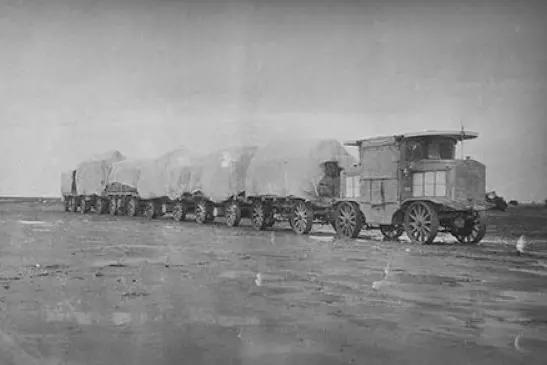
Buried in the pages of a local history publication is the story of what was described as a remarkable machine known as the German Road Train.
According to the account, the vehicle passed through Euroa in early 1914.
Weighing 90 tons and travelling on 44 wheels, it was described as Australia's first road train, not needing rails.
Remarkably, it was also electrically powered.
Developed in Europe in the years leading up to the First World War, the machine had originally been conceived with military purposes in mind before being brought to Australia in late 1913 for a far more peaceful task: hauling wool from the Riverina.
Unlike modern electric vehicles, the road train did not rely on batteries.
Instead, two six-cylinder Daimler engines in the lead vehicle generated electricity, which was then transmitted by cables to electric motors fitted throughout the following trucks.
The result was a hybrid of mechanical and electrical engineering decades ahead of its time.
The train's steering system was equally innovative, allowing the following vehicles to track in the wheel paths of the lead unit and negotiate corners on roads that would otherwise have been impossible for such a large machine.
Its journey to the Riverina was far from smooth.
The account records a series of mishaps and breakdowns before the road train eventually reached Benalla, where it encountered another obstacle when permission to cross a bridge was refused.
Engineers reportedly overcame the problem by taking the generating vehicle across first and then driving each of the remaining trucks across individually using a long electrical lead.
Although the road train eventually reached Wagga Wagga, its working life was disappointing.
One of the electric motors reportedly burned out, the vehicle struggled to fulfil its promise, and it was eventually sold for scrap in Melbourne.
Still, the story serves as a reminder that while electric trucks may seem like a modern innovation, the idea of electrically powered heavy transport has been travelling Australian roads for well over a century.
And, if the historical account is correct, one of those pioneering machines rolled straight through Euroa on its way north.