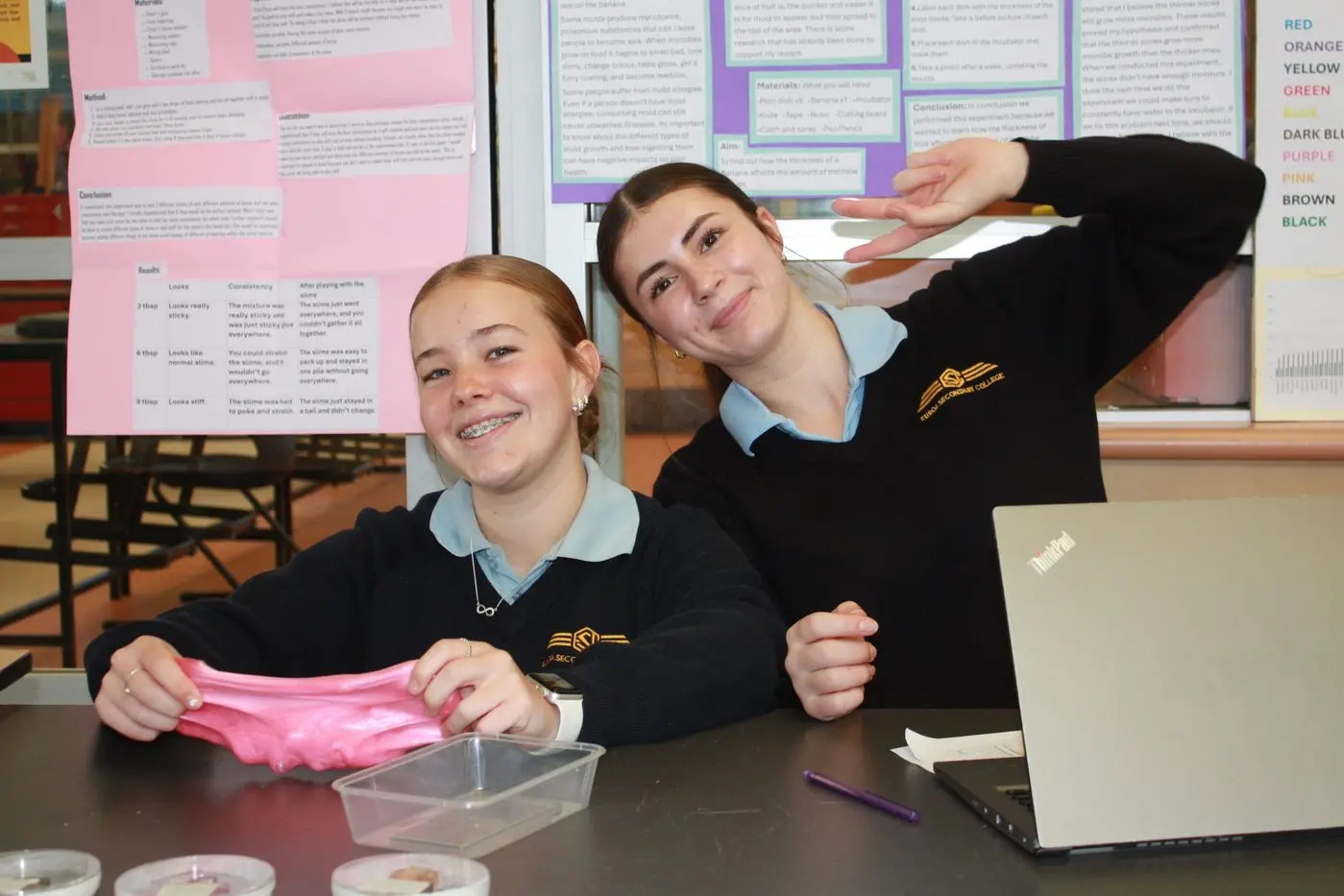
SCIENCE is everywhere and it plays a role, large and small, in every part of our lives.

At Euroa Secondary College the students were part of National Science Week last month, a national celebration of science and technology.

Adrian Bright and Kim Brown, science teachers at Euroa Secondary College, challenged their year nine science students to put their imaginations to work and devise scientific experiments to display to all their classmates at a science fair.

Also attending the science fair were the younger students from St Johns Euroa and the Euroa Primary School, and the little ones from the Euroa Kindergarten.

The aim of the science fair was for students to show how they investigated a scientific question, then to present the answer in such a way as to intrigue and wow the students and themselves.

"It is important that students learn that it is not enough to be able to prove something – they have to be able to communicate their findings clearly,” Mr Bright said.

Rockets flew, viscosity was measured, and the flammability of elements compared.

It was a fantastic opportunity for students to show what they had discovered and a massive undertaking by the teachers and Euroa Secondary College students that made the day the great success that it was.

Ms Brown spoke of the day's success.

“Students being able to take a passion or interest of theirs and create an experiment, then share their findings with an eager audience, was very rewarding," she said.

"It was impressive to see that the students were able to adapt their communication skills when discussing the science behind their experiments, to suit the various ages of the students who visited the fair.”

Euroa Secondary College also hosted a hands-on night viewing display, by Emma Barnett from Victorian Space Science Education Centre.

Emma came armed with an amazing knowledge in astronomy and a very impressive telescope.

After an introduction from Emma, the telescope was unpacked and assembled from the numerous boxes.

Emma invited students to help her assemble the amazing piece of science technology.

Once the telescope was in millimetre perfect position, those attending the night display were invited to observe the darkening sky.

Although there was some cloud, it did not deter the expressions of wonder from those lucky enough to be part of the fun.

Brian Greene, professor of physics and mathematics at Columbia University, puts the importance of science in our lives simply.

“Science is a way of life. It is a perspective," he wrote in a 2008 opinion piece for the New York Times.

"Science is the process that takes us from confusion to understanding in a manner that’s precise, predictive, and reliable – a transformation, for those lucky enough to experience it, that is empowering and emotional.”