
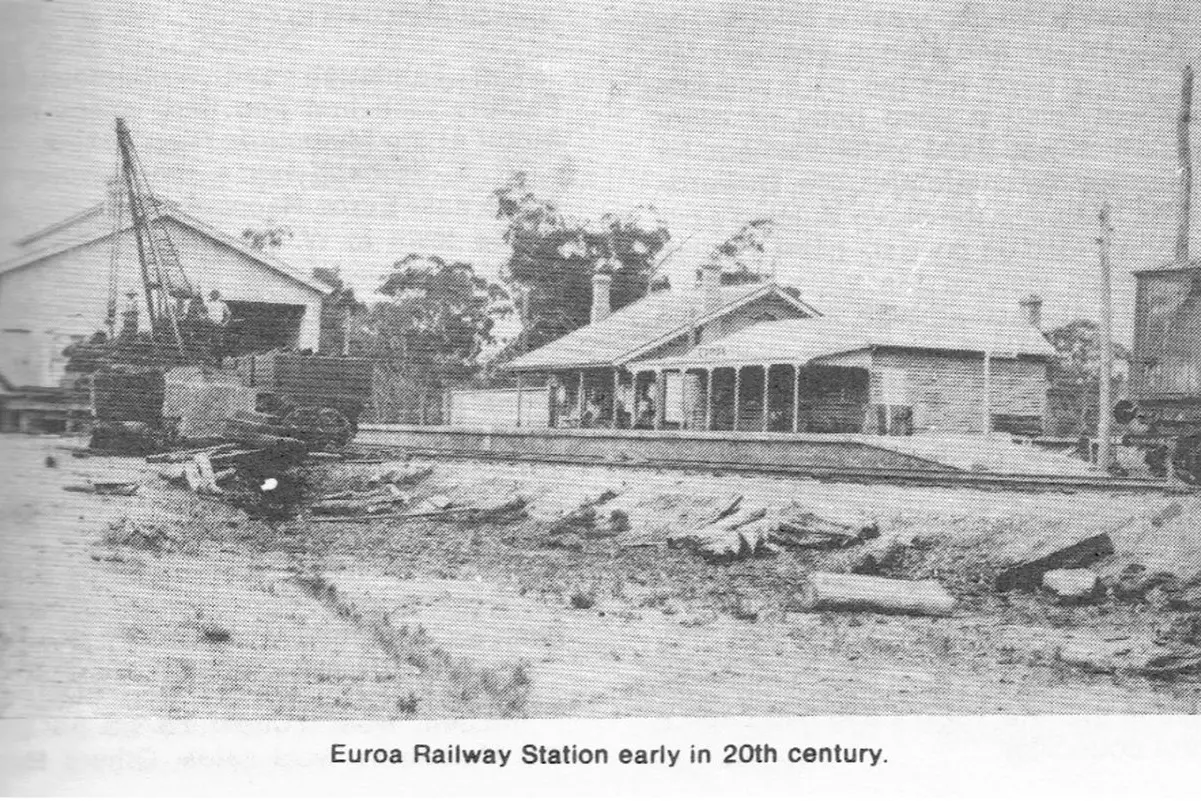
PHOTO
MY MEMORIES OF THE GOODS SHED
By MICK WILLIAMS, as told to Ann Shovelton
AFTER World War II, the Euroa Railway Precinct around the Euroa Goods Shed was a hive of activity for our local industries.
I worked with Peter Gavin who ran a general carrier business in the Euroa district for many years.
In that time all goods were transported to our district on the Goods Trains to the Euroa Goods Shed which was run by people like Phil Downing, Jack Braddy and Fred Pearson.
In those days we drove to the Euroa Goods Shed from De Boos St where Moynehan’s Grocery Store was and The Beehive Store.
We delivered to other local grocers including Moran and Cato and Lin Ferguson on the Highway, now known as Clifton St.
All groceries were delivered to the goods shed by train.
We collected beer from the goods shed and delivered it in barrels and boxes of a dozen bottles to each of the three hotels.
Because we had the train timetables we knew when the goods arrived and where they would be unloaded.
The staff at the Euroa Goods Shed had a schedule and location for regular deliveries and transfers.
The Seven Creeks Hotel received Richmond bottles of beer, and barrels.
The Euroa Hotel received Carlton bottles and barrels.
The North Eastern Hotel received Abbots bottles and barrels.
Only once did my father, a general carrier, have to travel to Melbourne for a grocery delivery for Burtons Stores.
At that time the Goods Train was shunted off the main train line and ran through the Euroa Goods Shed on a track which rejoined the main track further past the Euroa Goods Shed.
The decades after WWII saw a high demand for wool and the Euroa area was famous as a famous wool producing area.
Added to that, farmers tried to shear sheep in spring so wool bales arrived at the Euroa Goods Shed in large numbers in spring.
Wool bales were unloaded from general carriers’ trucks onto a platform in the Euroa Goods Shed which enabled the staff to load bales straight onto the goods trains as they drove through the shed.
Dick Rowarth had a mail run and brought wool to the EGS before collecting the mail for delivery mainly in the Strathbogie area.
Roy Gardiner carted a lot of wool to the EGS too.
My father, Mick Williams Snr, normally carried timber from Straughan and Davies who operated a timber mill in the Strathbogie Ranges.
The timber was prepared for house construction.
My father delivered the timber to the Euroa Goods Shed area where it was transferred to the Euroa Goods Shed so that it was easy to load onto a goods train to Melbourne.
Timber was in high demand for housing during the late 1940s, 1950s and 1960s after WWII.
There was another area in the railway precinct near the Euroa Goods Shed which was where superphosphate was unloaded and carried by our local general carriers to farms for spreading on pastures.
Murray Colclough carried a lot to our farmers.
Jimmy Cummins and Ken McLaine worked in the super area at the EGS.
The farmers in our area bought sheep from the northern areas to cross with their merinos to breed first cross lambs for meat.
The sheep were unloaded at the Euroa Goods Shed area near the Nissan Hut.
They were taken to farms by stock carriers or if they were ready for sale at Newmarket they were loaded onto rail stock carriages and taken to Newmarket, Melbourne.
Jim Sheargold managed another area near the Euroa Goods Shed which was the area for receiving and sawing wood for burning for heating and cooking .
The wood was sold mainly in Melbourne after it was transferred by goods trains to Melbourne.
The EGS was an important part of the timber industry in the Euroa area.
There were seven saw mills operating in the area at one stage and they employed many men with families who depended on the steady work locally.
The Euroa Goods Shed was an integral support for all our local industries from its construction in 1873.
~
THE CASE TO SAVE THE SHED
By JOHN PEARSON
Originally written as a letter to Heritage Victoria, dated March 10, 2024
I HAVE lived in Euroa most of my life and have a long involvement in railway work between Seymour to Benalla.
My grandfather was the station master at Euroa for many years. I was the fireman for the steam trains which transported the goods to various goods sheds along the line.
In past years the goods were delivered to Seymour and were loaded onto the goods train in line order of the stations ahead.
The carriage which contained goods for say Euroa was shunted to the goods shed at Euroa.
The goods were ordered by local businesses and stored in the goods shed until they were normally delivered to local farms and businesses by transports.
Locally the rail and transport industries were critical for the development of agriculture, the saw mill and timber industry, retail businesses and household heating when people used briquettes for heating and cooking.
The Euroa Goods Shed is one hundred and one years old and is repairable despite what the ARTC report says.
We've had many storms and bad weather in the past one hundred years and it's still standing.
It is an important part of our local, rural, industrial, transport history which must be protected for the benefit of future generations.